)
)
)
The (sucker) punchline for brands
Economic pressures are changing how customers behave – with transformative impact on how they shop. In this three part look at a baker’s dozen of datasets, we delve into how consumers view their own behaviour, what that means for brands and how they can react
Part 1 – the simple economics facing consumers and how that translates into shopping habits
Part 2 – how that translates into ‘spending occasions’ and what that means for loyalty in an AI assisted world
Part 3 – how brands need to rethink how they market to customers and where, ultimately, people actually buy things – and it’s not where you think
Part 3: The (sucker) punchline for brands
TL;DR ⬇️
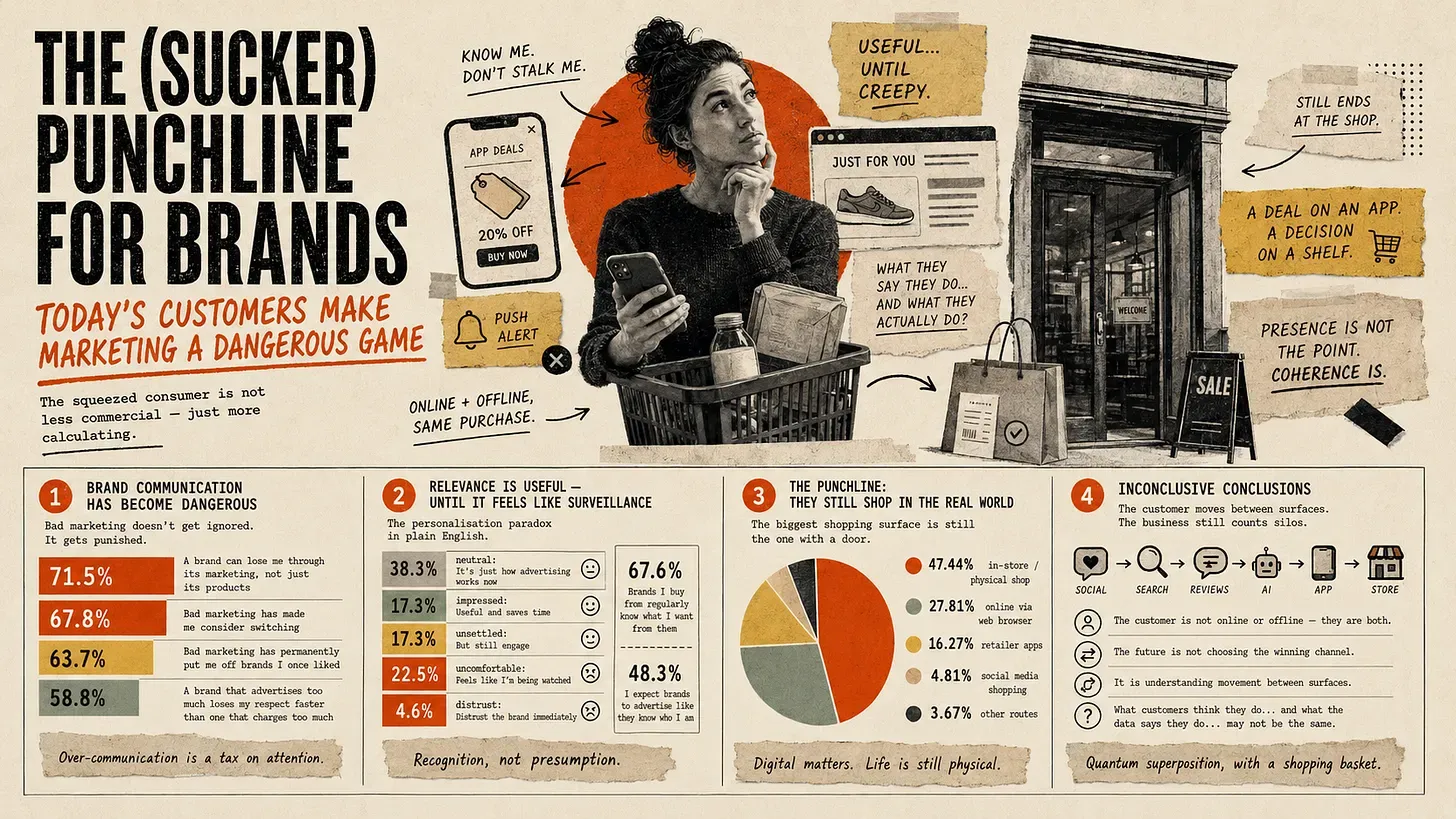
Customers are not just judging brands by what they sell, they are judging them by how they communicate – with 71.5% warning that a brand can lose them through its marketing, not just its products.
That matters because the squeezed consumer is already doing mental arithmetic all day: price versus quality, bills versus treats, loyalty versus switching, convenience versus cost. Bad marketing adds another burden.
But relevance is complicated. Consumers want brands to know enough to be useful, but not so much that they feel watched. Personalisation is welcome when it creates value – a better price, a smoother experience, a useful reminder, a smarter recommendation. It becomes creepy when it looks like surveillance dressed up as service.
The final twist is that, for all the talk of AI, apps, social commerce and digital discovery, the biggest shopping surface is still the one with a door. Consumers say 47.44% of their shopping still happens in-store, compared with 27.81% online via a browser, 16.27% through retailer apps and just 4.81% via social media.
That does not mean digital is less important – it means digital influence often becomes visible somewhere else. An ad may spark interest, AI may narrow the options, reviews may reduce risk, an app may provide the voucher – but the final purchase may still happen in an aisle.
The customer is not online or offline. They are both, often in the same purchase. So the lesson is simple: consumers do not think in sectors and they do not think in channels. They think in tasks, moments, needs and justifications. They shop wherever it makes sense at the time.
Contents-
How brand communication has become dangerous
-
Relevance is useful until it feels like surveillance
-
The punchline: they are still shopping in the real world
-
Inconclusive conclusions
Despite large sums being spent on marketing – $131bn in Europe on digital marketing alone in 2025 according to IAB Europe – not ‘doing marketing right’ in the new consumer world outlined in parts one and two can actually lose you your customers.
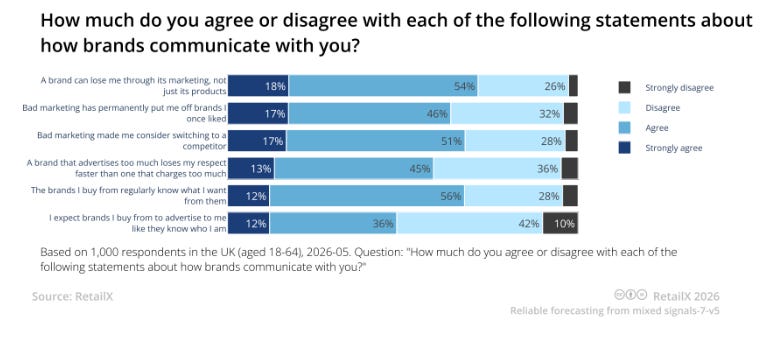
The marketing chart above shows where things become most dangerous for brands. Some 71.5% agree or strongly agree that a brand can lose them through its marketing, not just its products. Some 63.7% say bad marketing has permanently put them off brands they once liked. Some 67.8% say bad marketing has made them consider switching to a competitor. And 58.8% agree that a brand that advertises too much loses their respect faster than one that charges too much.
That last finding should be taped to the wall of every marketing department. In a squeezed economy, over-communication is not harmless, it is a tax on attention. Customers are already doing mental arithmetic all day, weighing bills against treats, quality against price, loyalty against switching, convenience against cost. Bad marketing adds another burden.
Brands often assume poor marketing is simply ignored. The data suggests otherwise. In fact, it can actively destroy value and it can turn preference into irritation and make a customer consider switching even when the product itself has not failed. To look at that another way, in an attention economy, it is the brand that is ultimately pays the bill for distracting busy customers unnecessarily.
And yet, again, the consumer is contradictory. Some 67.6% agree that the brands they buy from regularly know what they want from them. But only 48.3% agree that they expect brands they buy from to advertise to them like they know who they are.
The customer wants recognition, but not presumption. They demand relevance, but not intimacy. They want the brand to remember the relationship, but not behave as though it owns them.
This is the personalisation paradox in plain English: know me enough to be useful, but not so much that you become creepy.
Relevance is useful until it feels like surveillance
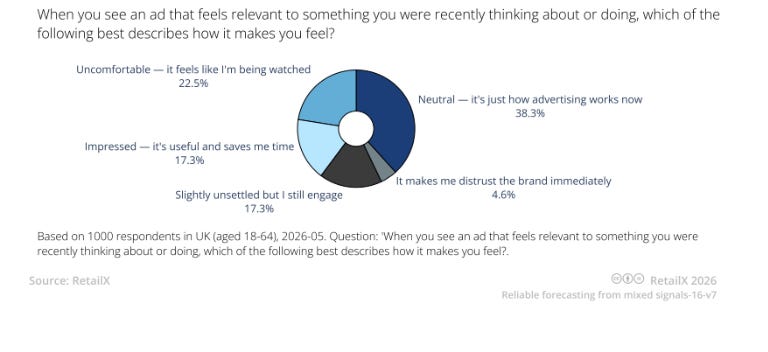
The penultimate chart (above) captures this paradox perfectly. When consumers see an ad that feels relevant to something they were recently thinking about or doing, the largest group, 38.3%, feels neutral: “It’s just how advertising works now.” Some 17.3% are impressed because it is useful and saves time. Another 17.3% feel slightly unsettled but still engage. Yet 22.5% feel uncomfortable because it feels like they are being watched and 4.6% distrust the brand immediately.
So, relevance is not one thing but rather it is a gamble. The same ad can feel useful, normal, unsettling or creepy depending on the recipient, the moment, the category, the signal used and the way it is delivered. The consumer may engage even when unsettled and may appreciate the convenience while disliking the implication. They may accept the mechanics of modern advertising without feeling affection for the brand using them.
This is where the future of customer interaction gets complicated. The more brands know, the more useful they can be. But the more they appear to know, the more they risk triggering suspicion. The customer does not reject data-driven relevance, they reject unexplained relevance – the feeling that the brand has been watching without giving anything back sits uncomfortably.
This, then, makes value exchange central. If data creates a better experience, a better price, a better recommendation, a smoother service, or a more useful reminder, consumers may tolerate it, may welcome it. If it simply creates more ads, more frequency and more pressure, it becomes another reason to leave.
This is the real lesson of the RetailX data. Consumers are not becoming more simple, they are becoming more conditional. They are not cutting back in a neat line, they are cutting differently. They are not abandoning brands, they are putting them on probation. They are not rejecting marketing, they are punishing bad marketing more quickly. They are not refusing AI, they are using it carefully, while keeping control. They are not loyal to sectors, they are loyal to the parts of life they want to preserve.
The brands that win will not simply be the cheapest, loudest or most personalised, they will be the ones that understand the customer’s private arithmetic: the emotional maths that sits behind every pound spent. The squeezed consumer is not less commercial, they are simply more calculating, more inventive and much harder to categorise.
The punchline: they are still shopping in the real world
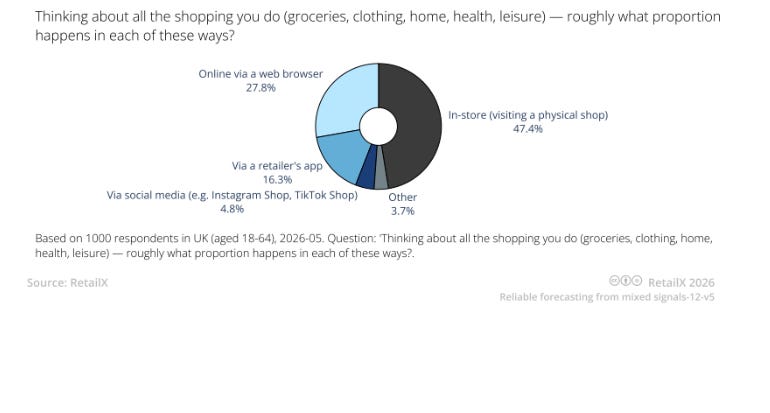
After all that, the strangest number may be the most ordinary one. For all the talk of social commerce, retail apps, AI assistants, personalised ads, recommendation engines and digital discovery, consumers say the largest share of their shopping still happens in-store.
Across groceries, clothing, home, health and leisure, 47.44% of shopping happens by visiting a physical shop. Online via a web browser accounts for 27.81%. Retailer apps account for 16.27%. Social media shopping, despite all the noise around TikTok Shop, Instagram Shop and creator commerce, accounts for just 4.81%. Other routes make up the remaining 3.67%.
That does not mean digital commerce has been overhyped. It means the customer’s life is still more physical than many digital strategies allow.
This is the useful corrective at the end of the data. Consumers may discover through search, check reviews, compare options through AI, respond to deals, feel unsettled by targeted ads and use apps to manage repeat purchases. But the shop – the actual shop, with shelves, staff, queues, weather, bags, children, impulse buys and forgotten lists – remains the biggest commercial surface.
The customer is not “online” or “offline”, they are both, often in the same purchase – in a state of quantum superposition. They may see an ad on social media, ask AI to compare options, check reviews on a retailer site, look for a better price on Google, open a retailer app to see if there is a voucher, then buy in-store because she is nearby, needs it now, wants to touch it, wants to avoid delivery charges, or simply happens to be passing.
That is the world we at CustomerX have to describe. Not ecommerce versus stores. Not apps versus browsers. Not social commerce versus retail media. The real story is that the consumer is moving across all of them, while the business world continues to measure them as separate things.
The numbers also reveal something else: the most fashionable shopping surfaces are not necessarily the most important ones by volume. Social commerce may be culturally loud, but it is still a small share of stated total shopping. Retailer apps matter, especially for loyal, repeat or convenience-led behaviour, but they do not dominate. The browser remains a major workhorse of comparison and buying, while the store remains the place where nearly half of shopping still happens.
This makes the earlier findings more important, not less. If consumers are cutting differently, protecting preferred categories, using deals as permission slips, policing quality more carefully and punishing bad communication, then those behaviours are not confined to digital channels. They are happening in aisles, at checkouts, in shopping centres, in retail parks, on high streets and in the messy overlap between the phone and the physical shelf.
A deal seen on an app may trigger a store visit. A review read online may decide which product gets picked up. A personalised ad may create interest, but a physical shelf may close the sale. AI may narrow the choice, but the customer may still want to see the thing before buying it. The store is not the opposite of digital. It is increasingly where digital influence becomes visible as behaviour.
This has awkward implications for brands and retailers. If almost half of shopping is still in-store, then any customer strategy that only understands clicks – on whatever surface, retail, leisure, travel – is missing the largest part of the picture. Equally, any store strategy that treats digital as something that happens elsewhere is missing the invisible work that happens before the customer arrives.
The future is not about choosing the winning channel. It is about understanding the customer’s movement between surfaces.
That is where CustomerX goes next. The first lesson from this data is that consumers do not think in sectors. The second is that they do not think in channels either. They think in tasks, moments, needs and justifications. They shop where it makes sense at the time.
Sometimes that is a store, sometimes it is a browser, sometimes it is an app. Other times it is social. Increasingly, it may begin with AI. But the customer does not care which box the business puts it in, they just want to make better decisions with zero regret.
So, the closing irony is this: the future of commerce may be more connected, more AI-assisted and more data-driven than ever, but the biggest shopping surface is still the one with a door.
But that is what customers think of themselves; what the data says they actually do is another matter, for another day…
Our cross-sector commerce summit, CustomerX, takes place on 14 and 15 October, 2026 in London. Come to copy, collaborate or compete across sectors, to grow your share of the customer’s disposable income. Registration is open. From the Supernova Theatre, to workshops, via One-to-One partnering meetings and ThinkTanks, it’s a chance to move from the screen to real life commerce connection.