)
)
)
The real deal: Why brands need to be clear about their own values if they want to reach customers
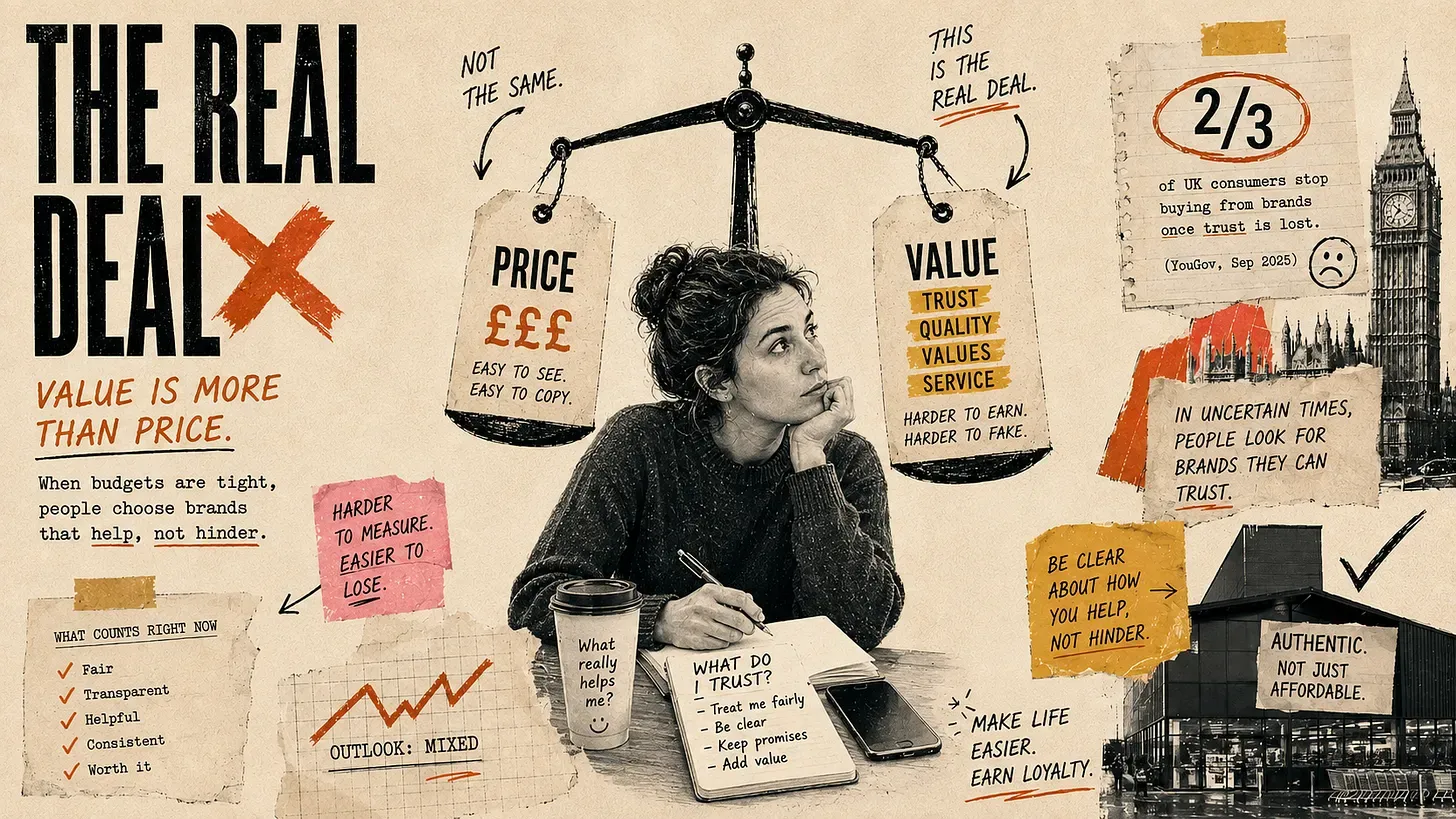
By drilling into RetailX consumer surveys, you get a vivid sense of people’s attitudes to their day-to-day spending. But this data says far less about the political, social and economic context within which thousands of individual purchase decisions are made. In this three-part article, we look at the bigger picture through the prism of the emotional state of the UK – meet the nation’s animal spirits
Part 1 – the political context and how long years of uncertainty since the global financial crisis have left UK voters weary. Or, why voters are suspicious about the idea that politicians can improve people’s lives
Part 2 – how the macroeconomic and political context shapes apparently contradictory behaviour and attitudes. Or, why recent graduates have entirely rational reasons to ask for both lower taxes and better services
Part 3 – why all this puts an onus on brands to build trust and to prove they offer, using the word beyond its narrow sense of a competitive price, value. Or, authenticity matters and brands cannot fake it to make it
Part 3: Why are so many brands making customers’ lives more difficult?
TL;DR ⬇️
Value and cheap prices are not the same thing.
Customers under financial pressure want brands they can understand and trust
Brands should maker their own values clear – and make life easier, not harder for customers when, for example, it comes to renewal time
Treat customers fairly, this is especially important when they’re watching every penny
Trust lost is value lost – and it’s hard to win back
Contents
-
Trust and how to build it
-
Don’t be evil, be better…
-
Values-driven propositions
As we have seen across Parts 1 and 2 of this series and also the latest posts from my colleague, Paul Skeldon, the idea of ‘irrational’ spending decisions is a misnomer. Customers make decisions based on circumstances. Many purchase decisions that seem somehow ‘odd’ or even ‘wrong’ appear this way because insufficient attention has been paid to the context of the customer’s decision.
The second main theme across Parts 1 and 2 has been around the ‘animal spirits’ that animate the economy. In the UK, these have been restive. While there has been what’s been dubbed a ‘Burnham bounce’, the Office For Budget Responsibility recently warned the government that continued disruption in the Strait of Hormuz may lead to the UK economy becoming moribund in 2027, with growth of just 0.3%.
It’s also worth noting that, following summer heatwaves across Europe, grocery bills may take a larger percentage of household incomes in 2027. While a predicted surge in prices in 2026 hasn’t as yet arrived thanks to a combination of competition between supermarkets, cost-cutting measures, increased efficiencies and better hedging against volatility, a combination of low crop yields, higher energy prices and supermarkets facing a squeeze on margins will surely tell at some point.
In short, the UK consumer looks likely to remain in straitened circumstances for a while yet. For brands, this has huge implications. While customers may still treat themselves, most will be keeping a wary eye on their family finances. According to the Office for National Statistics’ ongoing Opinions and Lifestyle Survey (OPN), the three issues most commonly cited in research conducted in July 2026 were the cost of living (by 88% of respondents), the NHS (78%) and the economy (70%).
Around three in five adults (61%) said they were either very or somewhat worried about rising costs of living, around the same number who thought their cost of living had risen compared to a month earlier (56%).
Trust and how to build itSo how should brands react? One place to start is with the issue of trust. According to YouGov research conducted in September 2025, two in five said they had lost trust in a brand because of unfair treatment. Two-thirds of respondents said they stopped buying from brands entirely when trust had been lost.
Despite this, UK consumers often have to work hard to get the best deals, as anyone renewing insurance, a mobile phone contract or a magazine subscription can testify. Despite best practice emerging that begins from the idea that customer acquisition and retention should be linked, the idea of the acquisition-retention loop, that’s often not how it seems to harried UK consumers.
Instead, they too often find themselves dealing with businesses where new customers seem to be treated better than those who have been loyal and getting the best price becomes an exhausting test of nerve that requires threatening to go to a competitor.
Faced with endless confirmation loops, support lines where nobody ever seems to pick up and hidden cancellation buttons, many customers don’t bother to change providers, but they are unlikely to have any affection for the brand making their lives difficult.
There are two important things to note here. Firstly, those who are intent on saving money are more likely to persevere, which should surely be a consideration for brands at a time when animal spirits are low. Secondly, if it’s difficult to leave, why would a customer consider going back if a new deal doesn’t work out? What will the customer say if a friend asks them about a brand they no longer trust?
Finally, don’t forget too that distrust can be almost visceral. Nobody wants to feel as if they have made a foolish decision. It’s physically uncomfortable. A purchase decision that, on reflection, wasn’t the best but didn’t involve feeling ripped off is not going to lead to the same degree of remorse and suspicion as feeling cheated.
Don’t be nasty, be better…But building trust is about more than not being horrible, it’s about offering value. But there’s a problem here that may be compounded by the ease with which we can measure prices in the digital world. Value is too often equated with being cheapest or offering a price that seems logical according to the market.
To begin with the second of those ideas, what happens when a business is selling a scarce commodity? The price goes up. While this may make sense to customers when booking plane tickets, where it’s relatively easy to understand that airlines will effectively offer a discount to those who commit early, customers are far less forgiving over the issue of dynamic ticket pricing to live events.
This became clear in 2024 when tickets for Oasis reunion shows went on sale and demand far outstripped supply. The band themselves hit out at Ticketmaster when fans were asked to pay £350 a ticket, £200 more than advertised. This kind of pricing certainly represents value to ticket vendors, who typically get a percentage of every ticket sale and thus have an incentive to increase prices, but does it really offer value to fans?
Conversely, just being the cheapest is rarely enough in itself. To pick up on one of the recurring themes of CustomerX, customers are not wholly rational beings selecting purchases based on perfect market information, life is messy.
Lidl isn’t just a success because it’s perceived as cheap, it’s because its proposition is understood by customers. Go to a branch of Lidl and there will be less choice than in other supermarkets, which can actually be a relief to customers when they’re tired and choice seems overwhelming, but prices will be keen. In addition, a combination of the world-of-horse-blanket middle aisle and themed promotions that highlight, for instance, items you need to make Italian or Thai food mean a trip to Lidl has its own changing eccentricities to take in. It feels authentic.
Values-driven propositionsThere’s a lesson here. One way to reframe the idea of value is to think of it as growing from values. A brand where the offering and perception are misaligned is potentially in difficulty. It doesn’t matter, for example, how much the water companies spend on upgrading infrastructure, or how often they point out that resources are limited and not every upgrade can be done at the same time, when they are doing this against a backdrop of executives getting huge payouts despite the government banning bonuses – and the execs themselves banning hoses. The water companies are speaking, but nobody wants to listen.
When it comes to water, because suppliers have local monopolies, consumers have no choice but to pay up. The same isn’t true in other aspects of life. One of the features in British retail in recent years has been the idea of the squeezed middle that has driven out all-things-to-all-people retailers such as department stores, which increasingly came to seem like businesses from another age as the 21st century lurched along.
And yet, even with department stores there have been successful turnarounds. While it has recently faced setbacks, John Lewis appears to be finding its feet again. Think John Lewis and you might think of its partnership model or it’s ‘Never Knowingly Undersold’ price-matching pledge.
Or think of the spectacular turnaround at M&S, which while not technically a department store chain, sells a combination of clothing, homewares, beauty products and food at its larger branches. For many, M&S represents the supermarket as treat and/or a place to buy wardrobe staples.
Actually, take a step back and both sell themselves on a kind of mid-market, middle-class consistency that chimes with their histories. Even for relatively well-to-do customers, this is immensely reassuring – authentic and even perhaps a little nostalgic in the sense of aligning with a perception of the brands that may date back to childhood. The value to the customer here resides not in price, but in trust.
To return to where we began this three-part series, the animal spirits of the country may be restive, but that in itself only emphasises the need for brands not to add unnecessarily to the noise and stress. It’s precisely in times like these that customers look for value – in its broadest sense. A brand that has a strong sense of what its offering should be and how this will help its customers has a far greater chance of succeeding in such an environment.
Our cross-sector commerce summit, CustomerX, takes place on 14 and 15 October, 2026 in London. Come to copy, collaborate or compete across sectors, to grow your share of the customer’s disposable income. Registration is open. From the Supernova Theatre, to workshops, via One-to-One partnering meetings and ThinkTanks, it’s a chance to move from the screen to real life commerce connection.