)
)
)
Lifting a lamp beside the golden door
Understanding who your customers are is a fundamental part of marketing and customer engagement, but knowing what mood they are in, which brain they are using – rational or intuitive – is perhaps even more important. In this two-part series we look at how a sandwich can keep you out of prison and how financial strains don’t have the impact you might expect on how people spend.
Part 1 – How the same customer can have a different ‘brain’ depending on how hungry and tired they are; just ask an Israeli judge.
Part 2 – How financial strains shape behaviour in ways that are often counterintuitive and what businesses need to do to understand their tired, hungry and poor customers.
Part 2: When scarcity takes up the bandwidth
TL;DR ⬇️
-
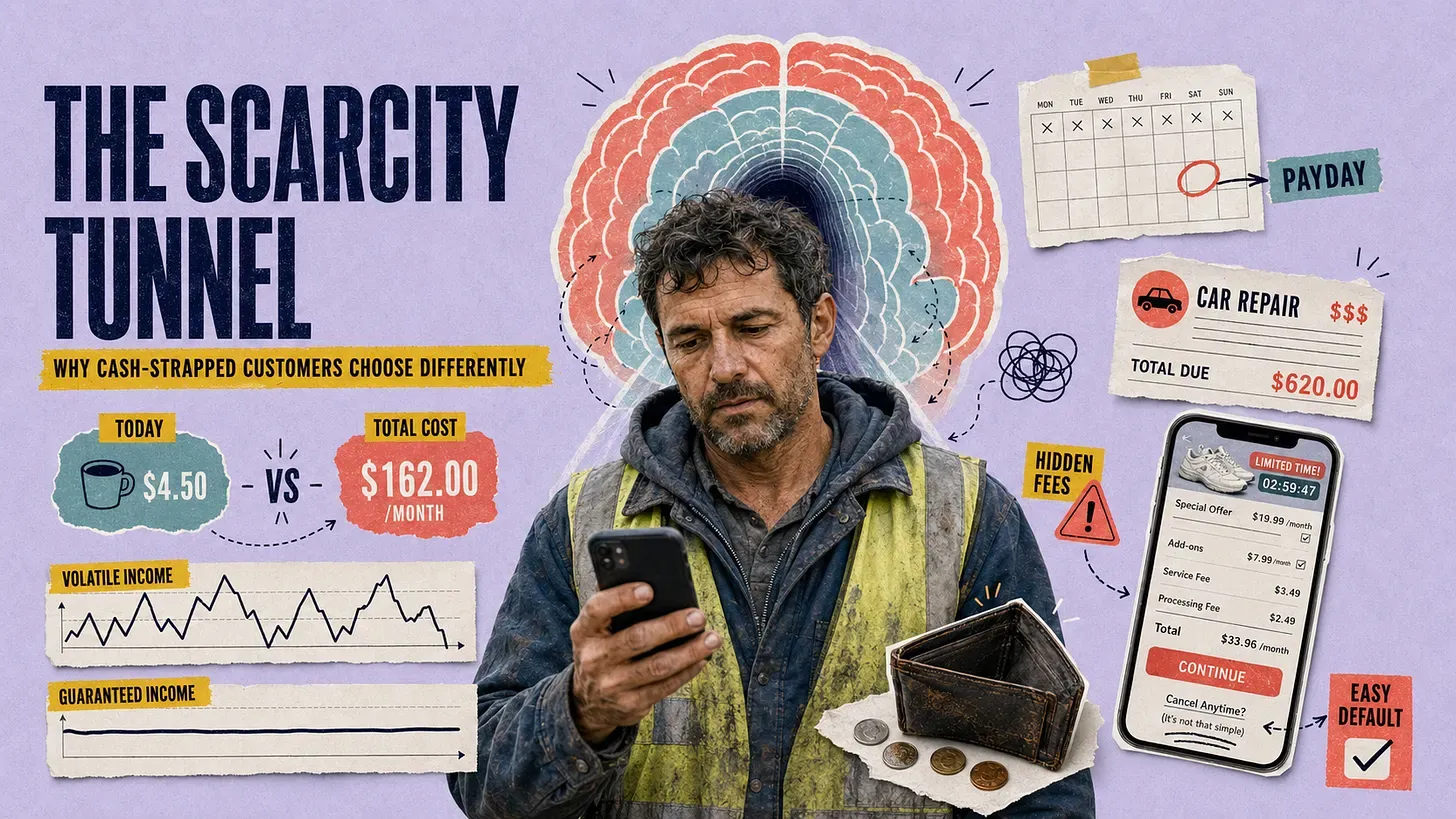
Financial scarcity does not make lower-income customers inherently less rational. It forces them into a ‘scarcity tunnel’ and changes the conditions in which they must make decisions.
-
Seemingly inconsistent behaviour – being price-sensitive one day, paying for convenience the next and treating themselves on payday – may be a rational response to volatile income and changing circumstances.
-
Greater economic security may widen customers’ decision horizons. Basic-income experiments suggest that predictable payments can support budgeting, planning, education and longer-term goal-setting.
-
Enshittification compounds scarcity. Hidden fees, subscription traps, preselected extras and difficult cancellation increase the mental work required to understand a purchase precisely when customers have the least capacity to perform it.
-
What looks like loyalty may be defensive risk reduction; what appears to be price sensitivity may partly reflect distrust; and what platforms record as customer preference may simply be the easiest option they allowed customers to select.
-
The essential question is no longer simply, “Who are these customers?” It is: “What pressures are shaping their decisions, how much uncertainty are we adding – and are we making their lives easier or their choices harder?”
Hungry, tired and stressed. All factors that drive customers make more intuitive decisions that need less literal glucose based energy than more stable rational thought and often leading to very different outcomes – just ask an Israeli judge. As we explored in part 1, Same customer, different brain, this impacts how customers shop and is as important as all the standard demographic information that brands typically use to personalise their engagement with customers.
The same principle becomes more powerful – and more sensitive – when applied to customers living with very little disposable income, something that has huge resonance as we trudge through the cost-of-living crisis.
It is sometimes claimed that poorer people make less rational decisions, plan less effectively and pay insufficient attention to long-term consequences. But that gets the causality backwards – and, incidentally, perpetuates the idea of a schism between the deserving and undeserving poor. Research suggests what is happening here is not down to something inherent in people on low incomes. Rather, financial scarcity changes the conditions under which decisions are made.
A landmark 2013 study asked shoppers to consider hypothetical financial problems before completing cognitive tests. Thinking about an expensive car repair impaired performance among lower-income participants but not among better-off participants.
The researchers also studied Indian sugarcane farmers, who receive much of their income at harvest. The same farmers performed worse on cognitive tests before harvest, when money was scarce, than afterwards, when it was relatively plentiful. The suggested explanation was that financial worries were consuming some of the mental bandwidth needed for everything else.
Scarcity can therefore create what researchers call “tunnelling”. Attention becomes intensely focused on the most pressing problem – paying today’s bill, feeding the family tonight or making the money last until Friday – while other considerations fall outside the tunnel.
This is not always irrational. In fact, scarcity can make people extraordinarily attentive to the immediate use of a limited resource. Someone with £20 remaining may think much harder about the difference between two grocery prices than someone with £2,000 in the bank. The problem is that focusing attention in one place leaves less of it available elsewhere.
In a series of experiments involving games with deliberately scarce resources, participants became more absorbed in immediate demands but were also more likely to borrow from future rounds, even when doing so ultimately left them worse off. The researchers argued that having too little can improve focus on the problem directly ahead while encouraging neglect of predictable future needs.
For consumers, that might mean choosing the product with the lowest payment today while paying less attention to its lifetime cost. They are solving this week’s transport problem with credit that makes next month harder, or taking an attractive promotion without fully processing renewal terms. Or, to use Sir Terry Pratchett’s famous ‘boots theory’ example, they are buying footwear that will cost more in the long run and still leave them with wet feet.
What appears from the outside to be a poorly considered decision may be a highly considered response to one urgent part of the problem – with the rest temporarily pushed out of view.
Low income also frequently comes with income volatility. Hours change, benefits arrive on fixed dates, unexpected bills consume carefully allocated money and relatively small shocks cannot be absorbed by savings. Research has found an association between volatile income and weaker financial planning, particularly where people feel they have little control over that volatility.
This can make spending appear less predictable to businesses. A cash-strapped customer may be extremely price-sensitive on Monday, pay for convenience after an unexpected shift on Wednesday and permit themselves a small treat on a Friday payday. Conventional segmentation may interpret this as inconsistency. In reality, the customer is responding consistently to a financial position that keeps changing.
The evidence should not be overstated. A critical review found mixed evidence that poverty consistently reduces cognitive capacity and only weak evidence that it necessarily increases preference for immediate rewards. The review of scarcity theory concludes that context, measurement and the particular decision all matter.
A 2026 study of low-paid workers in Ghana similarly found that pre-payday financial scarcity worsened cognitive performance and mental wellbeing but did not measurably alter risk aversion, present bias or overall decision quality.
A conclusion is therefore not that poorer customers are impulsive or incapable of planning. It is that they are required to make more consequential decisions, with less margin for error, under greater cognitive and financial pressure. Their choices may become more concentrated on immediate needs – and their spending more sensitive to payday, shocks and rapidly changing circumstances.
Once again, the customer has not changed – the conditions surrounding their brain have.
What happens when scarcity loosens its grip?
If financial scarcity can narrow attention towards the immediate problem, it follows that economic changes that reduce scarcity may alter the way people make decisions.
Universal basic income is particularly interesting in this context. The argument is usually framed around whether people would continue to work if the state guaranteed them an income. From a CustomerX perspective, however, the more interesting question is whether a reliable financial floor changes how far ahead people can think.
The Mincome experiment described here by the BBC took place in Manitoba, Canada, between 1974 and 1979. It was not a pure universal basic income because payments were adjusted according to household earnings, but it guaranteed participating families a minimum annual income.
When economist Evelyn Forget subsequently revisited the results, she found that hospitalisation rates in the town of Dauphin fell by 8.5% relative to the comparison group, with particularly notable reductions involving accidents, injuries and mental health. Young people were also more likely to remain in education rather than leave school early to work.
These are not direct measures of shopping behaviour. Nevertheless, they point towards something highly relevant to it: greater financial security can change the decisions people are able to contemplate. If a teenager no longer has to prioritise earning immediately, staying in education becomes a viable option. If a household can absorb a setback, the cheapest solution today may no longer be the only possible choice.
Finland’s basic income experiment offers further evidence, although it too tested a partial model rather than a genuinely universal income. During the research, 2,000 unemployed people received €560 a month without having to satisfy the usual employment conditions.
The effects on employment were small, but recipients reported greater life satisfaction, less mental strain and more confidence in their economic security, concentration and ability to influence their future. The researchers cautioned that the survey response rate and experimental design meant these wellbeing differences could not be attributed to basic income with certainty.
More directly, a large US study gave 1,000 lower-income participants $1,000 a month for three years, while a control group received $50. Those receiving the larger payment were 5% more likely to say they had a budget and 8% more likely to plan for large expenses. They were also more likely to consider further education and spent more time managing their finances.
OpenResearch concluded that the payments increased people’s capacity to formulate and pursue longer-term goals, although not everyone was equally able to turn those intentions into action.
The important ingredient may be predictability as much as absolute income. A regular payment creates something against which people can plan. It turns an unknown future into a series of at least partially knowable months.
The reverse is also true. Inflation, unpredictable working hours, benefit changes, rising interest rates and volatile energy bills can push previously comfortable customers into the scarcity tunnel. Disinflation, wage growth, predictable benefits or a guaranteed income can begin to pull them out again.
That would not necessarily produce a spending spree. Instead, customers might compare lifetime value more carefully, pay more upfront to avoid future costs, consider unfamiliar brands, save for larger purchases or invest in education, health and household resilience. Their choices may become less dominated by payday and today’s emergency.
Economic security does not make customers more rational, it gives them more room in which to be rational.
Enshittification consumes what bandwidth remains
Financial scarcity is not the only force narrowing customers’ choices. At the same time as many customers have less money and attention to spare, the digital services through which they make decisions are becoming more difficult to navigate.
Cory Doctorow coined “enshittification” to describe the progressive decay of digital platforms. A platform initially provides a valuable service to attract customers. Once those customers are locked in, it increasingly prioritises advertisers, sellers or other business customers. Eventually, it extracts value from everyone for the benefit of the platform itself. Search results become advertising inventory, useful features move behind subscriptions and straightforward transactions acquire fees, pop-ups and confusing choices. Doctorow sets out the process here.
Enshittification is broader than dark patterns – tactics that include preselected extras, hidden charges, false countdown timers, confusing consent choices, subscription traps and cancellation processes deliberately made more difficult than signing up – but dark patterns are one of its most measurable manifestations.
A European Commission behavioural study found that 97% of the popular websites and apps it examined contained at least one dark pattern. The most common included hidden information, preselection, repeated nagging, forced registration and difficult cancellation.
A separate study of approximately 11,000 shopping websites identified 1,818 dark patterns across 1,254 sites. These included recurring charges presented as one-off payments, items slipped into baskets and timers suggesting that offers were about to disappear when the supposed deadline was not genuine.
The effect on decisions can be substantial. In two large experiments, customers exposed to relatively mild dark patterns were more than twice as likely to subscribe to a dubious service as those shown a neutral interface. Aggressive dark patterns made them almost four times as likely to subscribe. Less-educated participants were especially susceptible to the milder, less conspicuous techniques.
This matters to financial scarcity because the two effects compound one another. Scarcity reduces the bandwidth available for considering the whole proposition and enshittification increases the amount of bandwidth required to understand it.
A customer focused on getting through the week is precisely the person for whom a low introductory price, preselected instalment plan or “offer ends in five minutes” message may become the dominant feature of a decision. The renewal charge is outside the tunnel. The processing fee appears only after considerable effort has already been invested. Cancelling is another task competing with bills, work and family demands.
Customers adapt by falling back on familiar brands, defaults, marketplace recommendations and the first option that appears good enough. Others abandon purchases, avoid subscriptions or assume every offer contains a catch. This has three profound impacts on what behaviour looks like:
-
What looks like brand loyalty may be defensive risk reduction
-
What appears to be price sensitivity may partly be distrust
-
What looks like a freely expressed customer preference may actually be the result of the platform making every alternative harder to select.
Enshittification does not merely make services worse, it transfers the work of making them usable back to customers – including those with the least money, time and cognitive capacity to perform it.
For businesses, the short-term numbers can be seductive. Hidden fees increase order values. Obstructive cancellation reduces churn. Urgency accelerates conversion. But these techniques manufacture intuitive decisions and then record those decisions as evidence of what customers wanted.
That is particularly dangerous in a CustomerX world. The brand that provides clarity, predictability and an intelligible total cost is not merely delivering a better interface, it is returning scarce mental bandwidth to customers – and may earn a greater share of their trust as well as their spending.
What businesses should do
The first step for brands is to stop treating financial circumstances as a fixed customer characteristic. Scarcity is a condition, not an identity. A comparatively comfortable customer can enter the scarcity tunnel following a redundancy, rent increase or unexpected bill, while someone on a low income may temporarily gain greater room to plan when their earnings become more predictable.
Economic change can therefore alter the way customers make decisions as well as the amount they have available to spend. Inflation, insecure work and volatile bills shorten the decision horizon. Rising real wages, predictable benefits or some form of guaranteed income may lengthen it again.
Brands should not assume that greater financial security will simply produce more consumption. Customers with more room to think may become more selective. They may pay more upfront for reliability, compare lifetime costs, avoid poor-quality products that will need replacing or invest in services that deliver benefits over a longer period. They may also become less responsive to artificial urgency and low introductory prices.
The opportunity is not merely to capture additional spending, but to serve customers whose definition of value is changing.
Brands therefore need to look beyond conventional demographic segments and design around financial context. Payday cycles, repeated visits, abandoned baskets and movement between premium and value products may indicate that customers are managing changing circumstances rather than exhibiting inconsistent preferences.
Predictability itself can become part of the proposition. Clearly stated total prices, advance notice of renewals, stable payment dates, realistic usage estimates and the ability to pause or change a service all reduce the number of future uncertainties customers must carry.
Such transparency matters because enshittified digital experiences currently do the opposite. Hidden fees, preselected extras, obstructive cancellation and false urgency transfer more of the work – and risk – of understanding a transaction to the customer. They consume precisely the cognitive capacity that scarcity has already reduced.
Brands should consequently audit customer journeys for cognitive cost as well as conventional friction. Friction is sometimes useful: a clear confirmation screen can prevent an expensive error. Cognitive cost is the unnecessary effort required to discover what something really costs, what has been added to the basket or how to escape a recurring commitment.
Finally, brands must change what they measure. Measurement should include unexpected cancellations, refund requests, payment failures, complaints, abandoned renewals and whether customers remain satisfied once the full consequences of the purchase become apparent. Immediate conversion without subsequent trust is extraction, not customer value.
Businesses, then, have become highly sophisticated at answering, “Who are these customers?” The more useful questions may now be: “What pressures are shaping their decisions, how much uncertainty are we adding – and are we making their lives easier or simply making their choices harder?”
Our cross-sector commerce summit, CustomerX, takes place on 14 and 15 October, 2026 in London. Come to copy, collaborate or compete across sectors, to grow your share of the customer’s disposable income. Registration is open. From the Supernova Theatre, to workshops, via One-to-One partnering meetings and ThinkTanks, it’s a chance to move from the screen to real life commerce connection.