)
)
)
Finding Growth Beyond the Usual Places
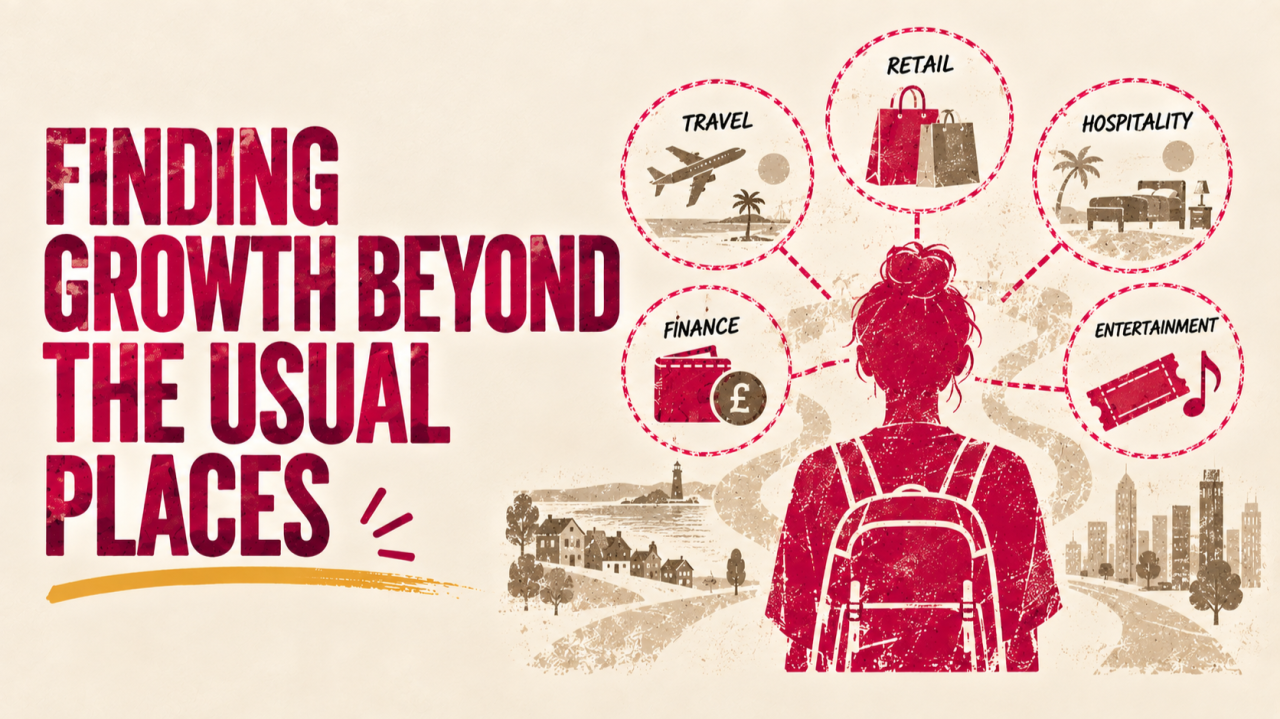
Every commercial director is staring at a familiar problem. Growth in the usual urban centres is flatlining. The cost of acquiring a customer in major metropolitan areas continues to climb and competing for discretionary spend feels like a zero-sum game.
The traditional playbook tells leaders to double down on familiar territories, but this approach often yields diminishing returns. Consumers in these oversaturated markets are fatigued, re-evaluating every interaction based on incredibly high baseline expectations.
Understanding where the actual growth lies requires a fundamental shift in perspective.
If a retail operations director only looks at central London or Manchester to drive conversion, they end up in an echo chamber. They sit and listen to the same competitors talk about the same minor incremental improvements.
We explored this geographical blind spot in our recent piece, Left-behind customers: why devolution needs to look beyond Britain’s cities and city regions. The analysis highlights how vast swathes of the consumer base are ignored by generic corporate strategies. These regional shoppers have finite wallets just like their urban counterparts, but they are dramatically underserved by brands that rely on city-centric models.
But geography is only part of the problem.
Businesses are also looking for growth through the lens of their own sector, while customers increasingly move between sectors without thinking about those boundaries at all.
That is one of the central ideas behind the CustomerX agenda this October.
Look across the programme and you find Eurostar and Collinson Group examining how travel, hospitality, retail and rewards partners can create connected loyalty ecosystems. easyJet & easyJet holidays, Butlin’s and Forge Holiday Group are looking at how connected commerce continues beyond the initial booking. Unilever, DAZN, SailGP and Uber Eats are coming together around the always-on fan economy.
These aren't disconnected industry conversations. They are different businesses trying to understand the same customer — and competing, directly or indirectly, for the same finite wallet.
The consumer has already erased the borders between industries, and they do not care about internal corporate regional mapping. A customer in a coastal town might easily abandon a frustrating digital retail basket to fund a premium domestic travel booking instead. Discretionary spend is highly contested everywhere.
To win a greater share of this finite wallet in underserved areas, commercial teams need to adopt a totally new mindset.
They copy. They collaborate. They compete.
Winning a greater share of this spend requires a fundamental shift in how you view consumer behaviour. Customers today are complex. A shopper in a regional town might trade down on their everyday household essentials just to ensure their annual family holiday remains untouched.
This contradictory behaviour means that single-sector thinking is completely broken.
If a grocery executive only looks at other supermarkets to understand how to drive loyalty in these regions, they miss the broader environment entirely. They need to understand exactly how a finance provider helps that same customer ring-fence funds for a protected occasion — or how a travel company creates value beyond the original transaction.
Innovation rarely happens in a vacuum.
If a regional rail operator or a domestic hospitality brand has perfected how to engage these neglected customers, a grocery director should not try to invent a brand new method from scratch. They should copy the mechanics of that success.
The fastest route to efficiency is finding a proven solution in another sector and applying it directly to your own challenges.
That is why sessions such as Building Connected Loyalty Ecosystems matter. What can a retailer learn from the way Eurostar approaches loyalty? What can hospitality learn from financial services? What could any of them build together that they couldn't achieve alone?
We are moving into a world of connected commerce where partnerships enable faster, smarter growth across all regions. A collaborative ecosystem that bridges retail and local leisure can engage a regional customer every single week, building loyalty that a standalone loyalty scheme could never achieve.
Understanding these diverse regional drivers requires more than just reading generic industry reports. A strategy relying on standard discounting to drive volume in towns and villages misses the broader market environment completely.
You need advanced data analytics and a willingness to break the single-sector loop. Technology alone is only part of the solution. You need the deep sector knowledge and peer-to-peer access to understand exactly how the consumer is navigating this borderless economy in the real world.
Creating environments where this cross-sector learning happens is exactly why we built CustomerX.
Ambitious leaders are hungry for actionable insights rather than abstract theory. When a senior hospitality executive sits down with a retail director, or a travel business exchanges ideas with a financial services leader, the resulting conversation can reveal completely different ways to protect loyalty, remove friction or capture spend.
They share what failed, what succeeded, and how they integrated the technology to make it happen.
Thirty qualified conversations with peers outside your immediate bubble can do more for your future growth planning than another thirty conversations with people facing exactly the same category constraints.
Achieving these objectives is difficult without the right environment.
Technology and innovation remain the great enablers of this cross-sector shift. You need the right tools to connect disparate systems and manage complex data architectures across different demographics. You need to see exactly what is working and why it succeeds in the real world.
And that is reflected throughout the CustomerX programme — from customer-led growth across commerce, platforms and service providers, to connected loyalty ecosystems, cross-company customer journeys, AI-enabled partnerships and the new ways businesses are competing for moments of customer attention and spend.
The market shift is happening right now, whether your current strategy accounts for it or not.
To reach customers you do not yet serve and find new paths to sustainable growth, you need to look beyond the places — and the categories — you already know.
Explore the CustomerX Agenda and see where those conversations could take your business.
14–15 October 2026 | Olympia London
Copy the best ideas. Collaborate with new partners. Compete for a greater share of customer spend.
Because the next growth opportunity might not be in your city.
And it might not be in your sector either.