)
)
)
Contradictory customers: How personal-level economics help explain ‘irrational’ spending
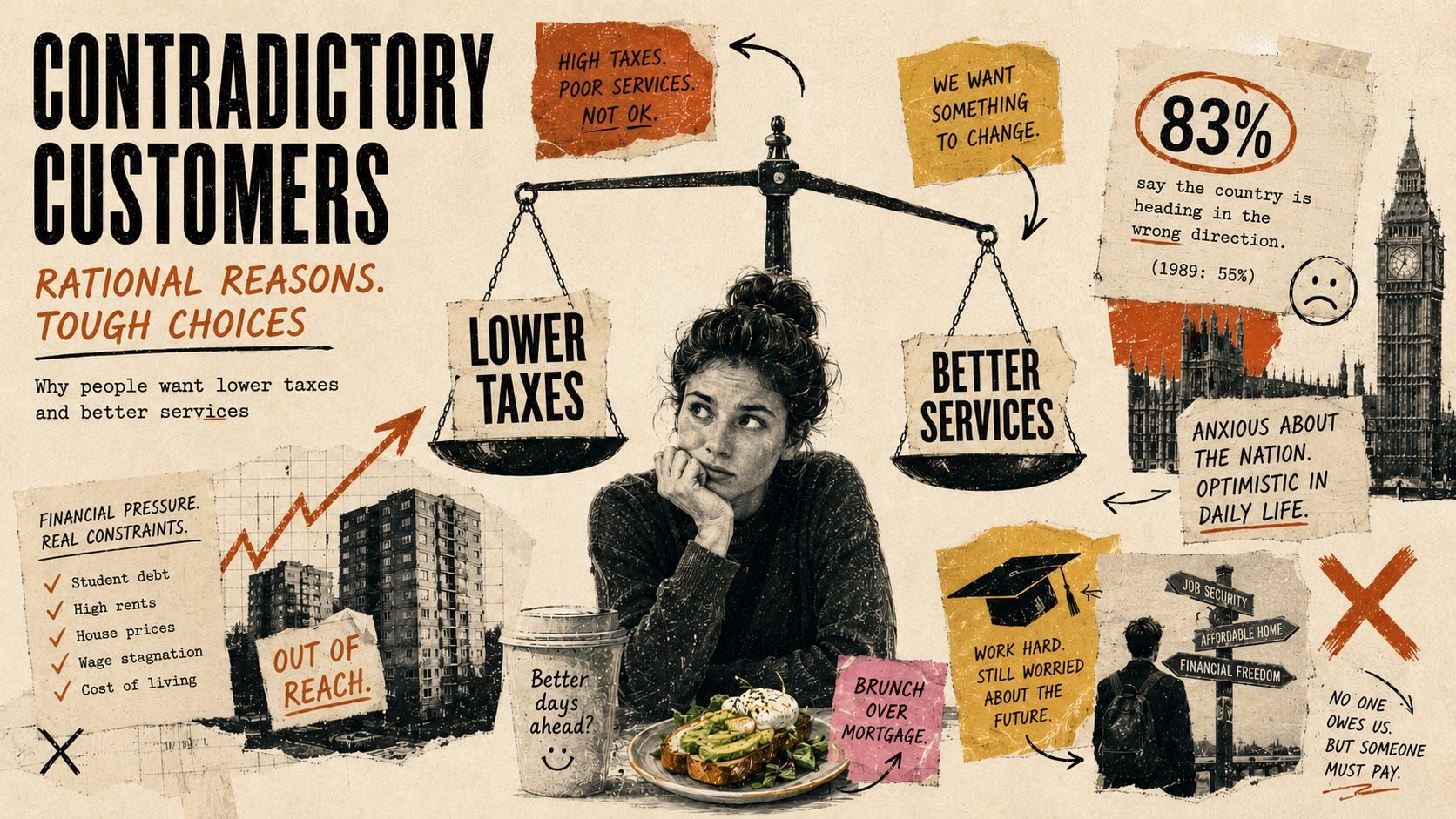
By drilling into RetailX consumer surveys, you get a vivid sense of people’s attitudes to their day-to-day spending. But this data says far less about the political, social and economic context within which thousands of individual purchase decisions are made. In this three-part article, we look at the bigger picture through the prism of the emotional state of the UK – meet the nation’s animal spirits
Part 1 – the political context and how long years of uncertainty since the global financial crisis have left UK voters weary. Or, why voters are suspicious about the idea that politicians can improve people’s lives
Part 2 – how the macroeconomic and political context shapes apparently contradictory behaviour and attitudes. Or, why recent graduates have entirely rational reasons to ask for both lower taxes and better services
Part 3 – why all this puts an onus on brands to build trust and to prove they offer, using the word beyond its narrow sense of a competitive price, value. Or, authenticity matters and brands cannot fake it to make it
Part 2: The lower-taxes-better-services conundrum
TL;DR ⬇️People in the UK are optimistic in their day-to-day lives and technologically connected, but anxious over the state of the nation and the economy
In 2026, 83% of UK respondents thought the country was headed in the wrong direction, making us far more pessimistic than in 1989
“NOwnership” is still with us, but for different reasons than a few years back
Conceptually, avocados equate to brunch, and why not spend your money on brunch if you despair of saving for a flat or house?
While there is a strong desire for better services and better social care, we cannot agree as a nation on how to pay to get these outcomes
Gen Z in particular faces significant financial strain from student debt and rising housing costs
Faced with a high tax burden and low-quality services, it’s not irrational for younger cohorts to want lower taxes and better services. What that means is another matter: it could be younger workers want older people to pay more
Contents-
What Andy Burnham’s social care initiative tells us
-
Somewhere down the road
-
GenZ and their many discontents
-
Uneven change through different demographics
As consumer research from RetailX reveals, there’s nothing simple about why we choose to spend our money as we do. People will economise in one area to spend in another, cutting differently as my colleague, Paul Skeldon, neatly framed this idea. But how does this idea work out in the real world?
In earlier articles, we have looked separately at the kinds of value-driven choices people make and the political context, the animal spirits of the nation. What happens when you begin to bring these two perspectives together? How do animal spirits shape customer behaviour at a gnarlier level? A recent report by Ipsos, We British: From Walkmans To Wi-Fi To What? offers some context.
Based on 40 years of polling and trend data dating back to 1989, Ipsos comes to three main conclusions:
-
“We are grumpier, more pessimistic and insecure today – but this frustration is directed externally at the state of the country more than unhappiness with our own lives.”
-
“We are more tolerant, inclusive, and hold fewer rigid rules on how people should live their lives. But we are still divided in our economic beliefs and how to reward and deliver economic growth while also looking after the vulnerable.”
-
“Our aspirations are broader, more widely shared and more outward looking. And the impact of technology on the way we live our lives is immense. But these new opportunities are bringing new stresses.”
The first and third points here certainly sound about right. Many of us are cheerful in our day-to-day lives, but get frustrated at potholes, long waits to access health services and a general shabbiness around us. We love technology, but we find it overwhelming. The second point is both familiar and, as we’ll see, plays into the themes of CustomerX in intriguing ways.
Perhaps one of the most striking statistics influencing these conclusions lies in people’s response when asked whether they think the country is headed in the right direction? In 2026, 83% of respondents said they agreed more with the statement “the country is heading in the wrong direction and major changes are needed”. In contrast, 10% identified more with the idea “the country is heading in the right direction and no major changes are needed”. The corresponding figures in 1989 were 55% and 33%.
But what should we do about this collectively? Here, the respondents’ answers are contradictory. While 79% of respondents identify with the idea of “a society in which the caring for others is more highly rewarded”, a figure virtually unchanged since 1989 (when the equivalent figure was 81%), just 58% are drawn to the idea of “a country which has a significantly higher tax-rate for ordinary taxpayers, in order to pay for the support of the elderly and poor” (down from 71% in 1989). We want something to be done, but there’s far less agreement on who should pay.
What Andy Burnham’s social care initiative tells usAgainst this backdrop, you can see the outline of the new prime minister Andy Burnham’s approach to social care, rhetorically mixing reaching for consensus while also promising to tackle a tough issue too long ducked. A reasonable explanation for this stance is that he’s in part pitching to those who are sympathetic to the idea of collectivism.
Simultaneously, he’s also proving his mettle to those who are instinctively suspicious of government intervention to tackle a problem where the bill is estimated to be £18bn – notably but not exclusively the 27% who identify with the statement “a country which has a significantly lower tax-rate for ordinary taxpayers and provides only minimum support for elderly and poor”. Burnham’s unspoken question here can be boiled down to: “You don’t like this, but what would you do instead?”
From the financial straitjacket of Labour’s 2024 manifesto to the ever-present potential for oil price shocks, there are all kinds of reasons to argue the approach won’t work. If that’s true, for retailers and brands trying to reach the British public, it seems reasonable to infer that, when people arrive at their contradictory decisions, they will do so in a nation where the animal spirits are low and that this will continue to be a defining factor in driving purchase decisions.
Alternatively, if Burnham can offer not just rhetoric, but his government begins to turn the economy around, there’s every chance the animal spirits will improve. And this isn’t necessarily a fanciful idea. The economic indicators have, overall, been surprisingly strong in recent months, albeit from a pitifully low base. Prime ministers need to be lucky as much as able, and it could be that Burnham will benefit from an improving economy leading to more willingness to spend.
Somewhere down the roadLooking five years ahead, what will the UK be like if Burnham succeeds? What will customers be spending their money on? There’s a temptation to look backwards, to assume things will return to a kind of pre-2008 state, but history rarely if ever repeats itself that neatly.
Consider, for example, the possible effects of demographic change. Boomers are dying off, but based on how the millennials-spend-all-their-money-on-avocados trope that emerged in 2017 still makes comebacks, not without having a good grumble first. Dig into this story-cum-meme and you soon encounter a much-quoted article by Blake Morgan about changing millennial spending habits.
Morgan described a world of “NOwnership” where millennials, including the author, had collectively decided to spend their disposable income on experiences over ownership. Think of the avocado not as, to get technical, a single-seeded berry, but rather a symbol of brunch with friends. Where things get really interesting here with the benefit of hindsight is when Blake quotes a Fast Company article from 2012 where writer Josh Dykstra says, “Ownership just isn’t hard anymore. We can now find and own practically anything we want, at any time, through the unending flea market of the Internet.”
At the risk of being a little unfair to Dykstra, someone writing in a pre-MAGA, pre-pandemic, pre-heat-dome-over-Europe world, this comes across as naïve from the perspective of 2026. Those who have followed on from the millennials, while still up for brunch, are far more likely to despair of ever having any spare money to buy stuff, as recent BBC reporting makes clear.
GenZ and their many discontentsSo what’s happened? To view this in purely financial terms in the UK, a hypothetical zoomer graduate might have begun university in 2015. They would have left three years later with a chunk of liabilities from Plan 2 student loans. Since April 2026, assuming they haven’t been lucky enough to settle these loans in full, they will have been repaying the debt at 9% of earnings over a threshold of £29,385. Compare such a graduate earning £39,385 with someone who is free of student debt. The graduate takes home £900 less a year.
When recent graduates are criticised for seeming to want both lower taxes and better public services – as happened a couple of years ago in the wake of Ipsos research on how older cohorts appeared to be more open to higher spending – this £900 figure is worth keeping in mind. In an era when the UK tax take is close to Scandinavian levels at 40% but services are perceived to be poor, might it be these graduates would like someone else to pay more to improve the public realm?
Or look at house prices. Even since our hypothetical graduate finished university in June 2018, average house prices for all property types in the UK have risen from £210,355 to £271,295, a 28.97% increase. Meantime, despite the post-pandemic inflation shock, wages have been essentially moribund or at best grown in historically low terms. Recent ONS figures, for example, reported real annual wage growth for those not owning property to be 0.4% for regular pay, 1.3% for total pay.
And yet focusing solely on finances is an inadequate way to frame what is happening. There’s a striking contrast between the world Morgan and Dykstra describe and today. One crucial factor here is that, c2012-2015, when at least interest rates were historically low, it seemed as if the global financial crisis might be receding into the past rather than forming part of a rolling polycrisis.
Uneven change through different demographicsIn short, the animal spirits have changed, change all the time – but not evenly. People across generations are under financial strain, but zoomers, many of whom see themselves as perhaps permanently locked out of home ownership, or even being able to afford to rent a flat, have been especially battered by events. And that’s before we have even mentioned a potential AI jobs apocalypse.
Let’s assume for a moment that, even as the economy improves, zoomers are wary of the social values of older cohorts who have the luxury of capital behind them, locked out of home ownership and, in just about every scenario you can reasonably imagine, still paying higher taxes than those who went before. How will this shape their purchase decisions? We may well move from a world of cutting differently to spending differently, a post-NOwnership world. (A thought experiment for another time incidentally, is there a partial yet key explanation for the rise of recommerce somewhere in here?)
None of this is to frame this wholly as a story of generational clashes. Rather, it’s a way of flagging up how geopolitical and economic factors have impacted on those in two of the cohorts that businesses will be trying to reach in the years ahead. There are shared experiences between the groups, but also distinct differences.
This affects both what each wants to buy and what each can afford to buy. And that’s before we have even begun to talk about inherited wealth, or class, or where people live, or educational attainment, or familial responsibilities. It follows that, to reach customers in the years ahead, brands need at least an understanding of the factors at play here.
Our cross-sector commerce summit, CustomerX, takes place on 14 and 15 October, 2026 in London. Come to copy, collaborate or compete across sectors, to grow your share of the customer’s disposable income. Registration is open. From the Supernova Theatre, to workshops, via One-to-One partnering meetings and ThinkTanks, it’s a chance to move from the screen to real life commerce connection.