)
)
)
The Summer Holiday Moment: a journey to purchase not just a destination
-
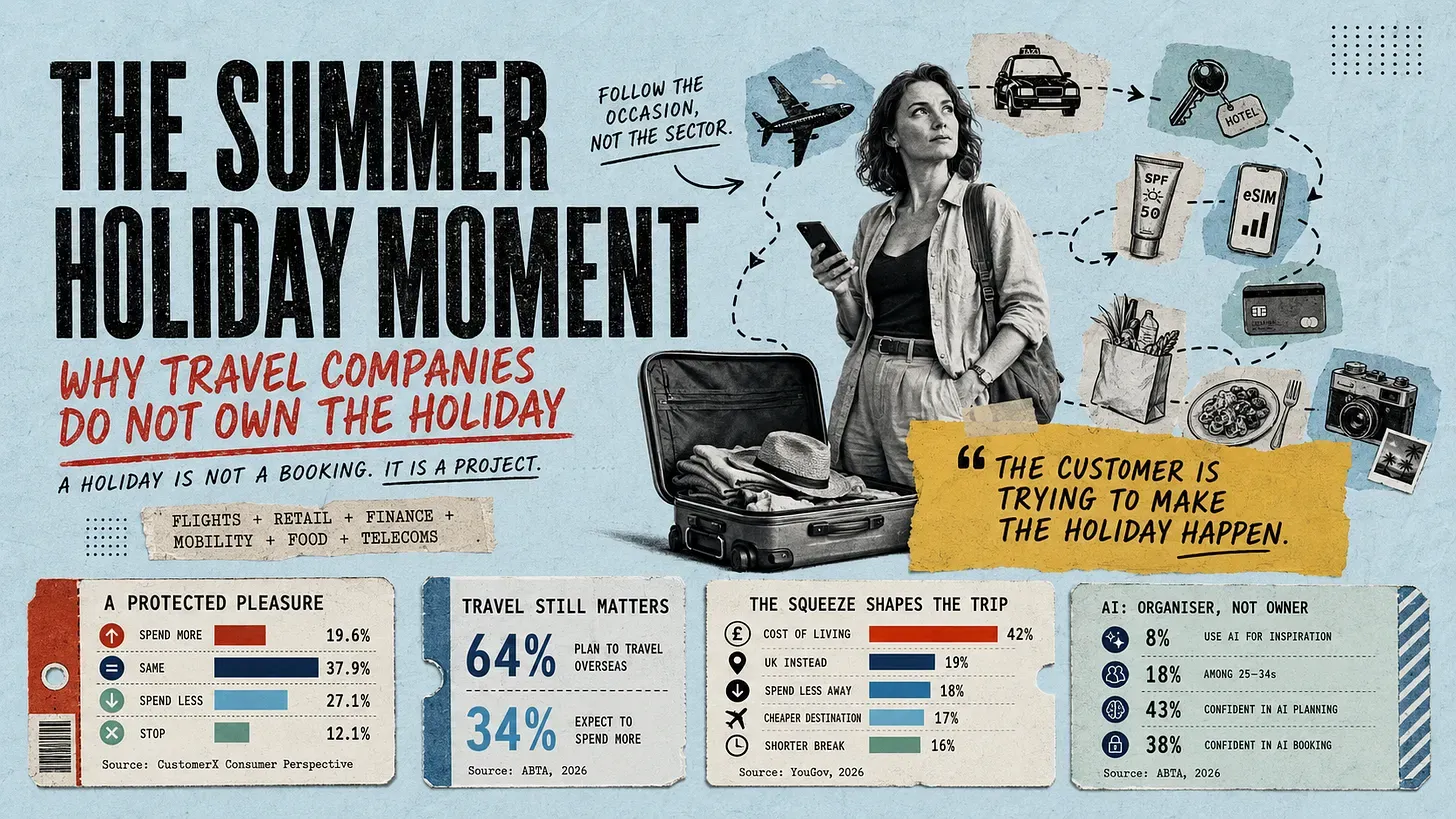
The summer holiday is not a single travel purchase but an extended commercial moment stretching from inspiration and booking to packing, travelling, staying and returning home.
-
Despite pressure on household budgets, holidays remain a protected pleasure for many consumers. They may spend less on eating out, clothes and entertainment to preserve the trip.
-
That spending flows far beyond airlines and hotels into retail, insurance, payments, mobility, telecoms, food, entertainment, pet care and home security.
-
Most businesses still see only their individual transaction, but the real opportunity lies in creating partnerships around what the customer is trying to accomplish – such as combining a holiday booking with insurance, luggage, airport transport, an eSIM and local services.
-
BA+Uber, Tesco+Virgin and Mastercard+Airport Fast Track all show the beginnings of interesting tie-ups to enhance travel for customers.
-
AI could become the organiser connecting these fragmented needs, but consumers currently trust AI more to research, compare and coordinate than to book autonomously.
-
No company can own the entire Summer Holiday Moment. The winners will be those that understand the context, make themselves genuinely useful and collaborate across traditional sector boundaries.
As many of us prepare to get away for a well-earned break, it is easy to think the summer holiday begins at the airport. But it doesn’t – it begins in January, when somebody looks out of the window at horizontal rain and starts browsing villas in Corfu.
Nor does it end when the plane lands. It continues through the taxi home, the empty fridge, the takeaway ordered because nobody can face cooking, the 600 photographs uploaded to the cloud and the credit card bill quietly waiting on the doormat.
To the travel industry, a holiday is a booking. To the customer, it is a project.
As a result, the money attached to the Summer Holiday Moment travels much further than the customer does. It moves through airlines, hotels and tour operators, certainly, but also supermarkets, fashion retailers, pharmacies, banks, insurers, restaurants, entertainment businesses, mobile operators, pet-care providers and transport platforms.
From the perspective of customers, it is all glued together through social media, where they find inspiration for everything from destinations to swimwear, and where they will share their experiences, interactions and many, many photos from booking to unpacking on their return.
Yet most businesses continue to approach customers separately when it comes to holidays. Each sees its own transaction but rarely the larger occasion connecting them. Customers, however, aren’t thinking in that siloed way, they aren’t looking in terms of simply who sells the holiday, but rather who understands the moment well enough to win their next travellers’ cheque.
Holidays occupy a curious place in the household budget. They are expensive, discretionary and, logically, should be among the first things cut when money is tight. Consumers being consumers, however, don’t see it like that. The CustomerX consumer survey we covered in our previous post, Customer are not cutting back – they are cutting differently captures this tension.
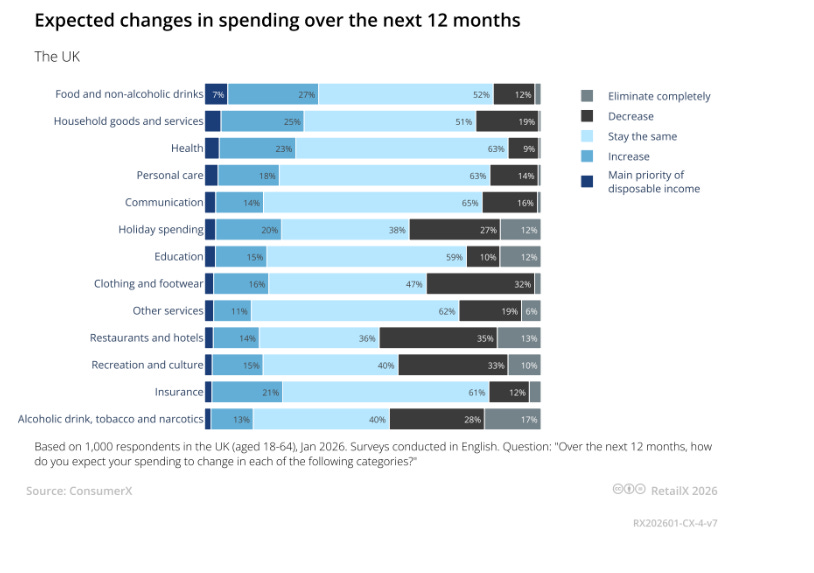
Despite the cost-of-living-crisis, some 19.6% of respondents expect to spend more on holidays, while 37.9% expect to spend roughly the same. While 27.1% do plan to spend less, just 12.1% expect to eliminate holiday spending altogether (see chart above). The holiday is therefore neither universally protected nor simply abandoned – it is funded by shifting spend from elsewhere.
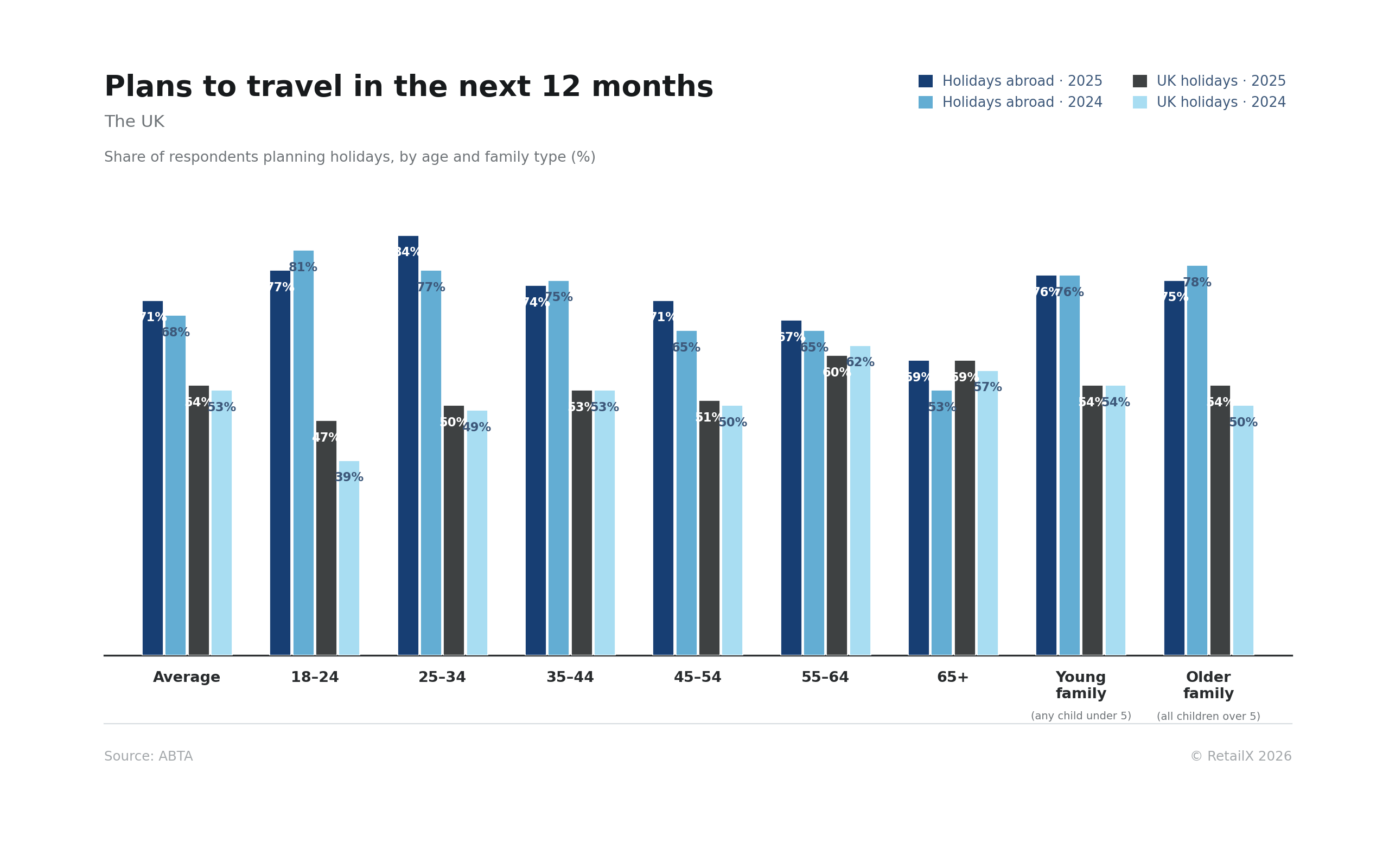
Current travel research reinforces this. ABTA found in June 2026 (above) that 64% of UK adults plan to travel overseas during the next 12 months and 34% expect to spend more on holidays. Asked what they would cut to cope with the cost of living, consumers put eating out, leisure activities and clothes ahead of overseas holidays.
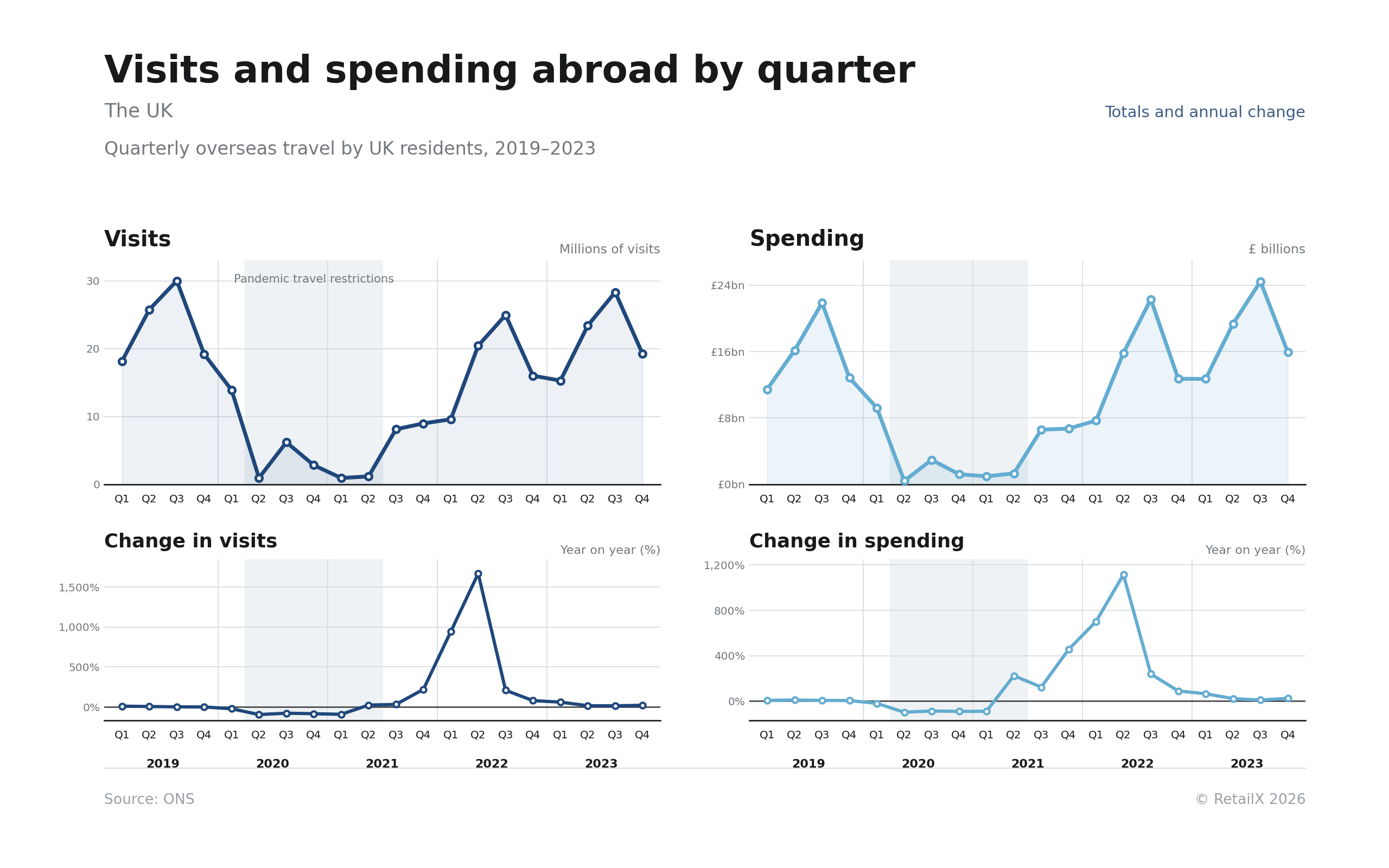
According to the Office for National Statistics’ developing estimates (above), UK residents made 94.6 million visits abroad in 2024 and spent £78.6bn. Spain alone received an estimated 17.8 million visits from residents of Great Britain.
But even that formidable figure does not capture the whole Summer Holiday Moment economy because much of the associated spending happens before customers leav Britain or after they return.
The obvious money goes on transport and accommodation, but around it sits an expanding orbit of secondary spending: luggage, clothing, sun cream, travel insurance, foreign currency, airport parking, mobile data, meals, excursions, car hire, entertainment and, however informally organised, pet-sitting and house-sitting services,.
The orbit changes according to the type of holiday. A family staying in a self-catering villa has a different set of needs from a couple taking a city break, a solo traveller touring Europe or somebody attending a festival overseas.
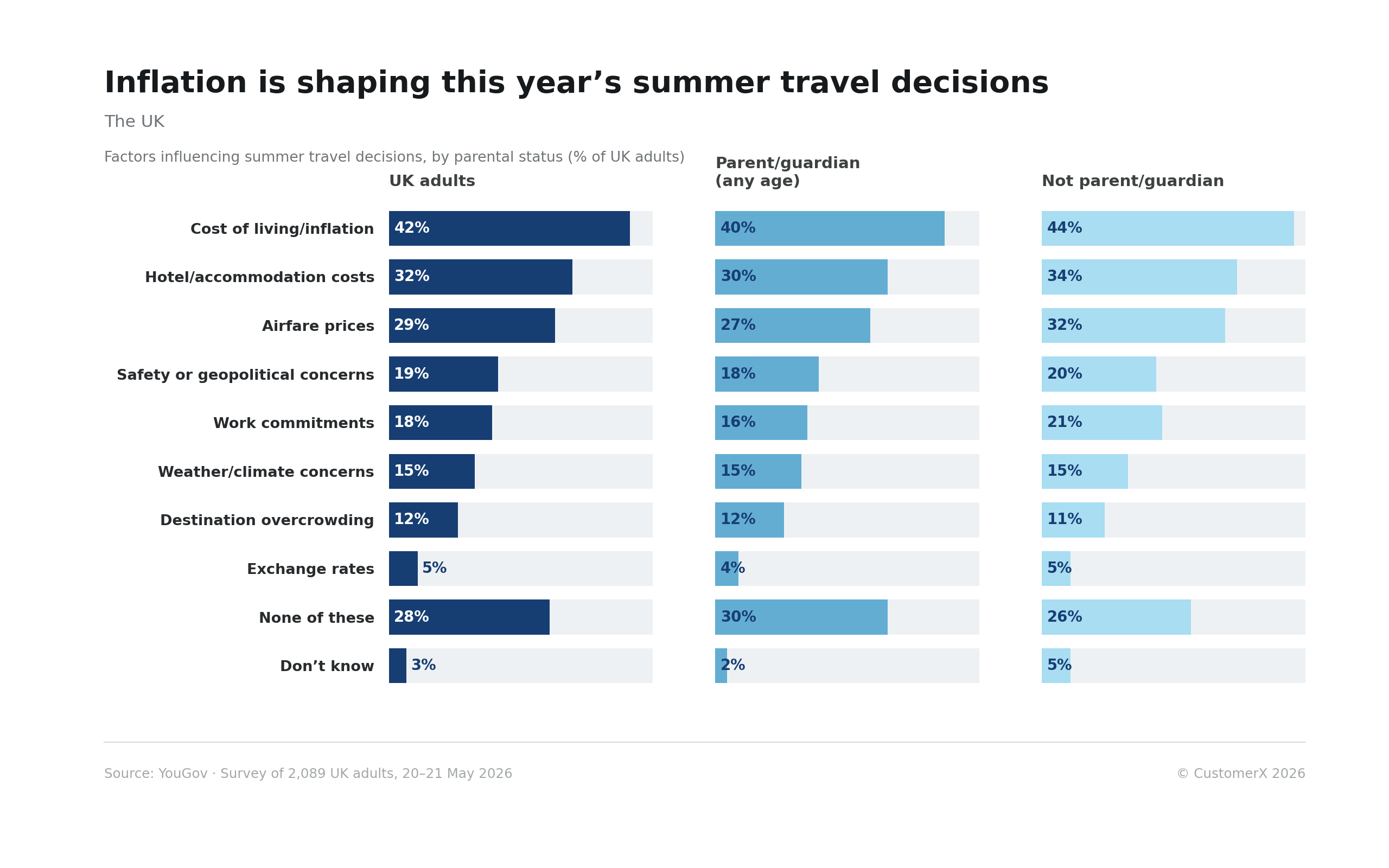
It also changes when budgets tighten. YouGov’s 2026 summer travel research (above) found that the cost of living is influencing the plans of 42% of UK adults. Among the adaptations worth noting:
-
19% are choosing a domestic holiday instead of travelling abroad
-
18% plan to reduce spending during the trip
-
17% are selecting cheaper destinations
-
16% are taking shorter breaks.
What do these figures mean in terms of overall spend?
-
36% still expect their summer travel budget to be higher than last year
-
21% expecting their spend to be lower.
Emphasising the complexities here, this doesn’t mean a third of customers are doing better than others. Because of inflation or new additions to the family, it may be that some customers have to spend more on the same holiday. Empty nesters may find their holiday is cheaper. Others may be cutting back to save for a bigger trip in 2027.
This is the calculating customer identified in the Consumer Perspective series we published here, here and here. The customer has not necessarily stopped spending, they are reallocating, substituting and trading down in some places so that they can protect what matters in others.
For businesses, this means that “holiday customer” is not a useful enough segment. The commercially important signals are the context, party, destination, budget and stage of the longer purchase journey.
A customer six weeks from a family beach holiday may need children’s clothing, airport transport, sun protection and roaming data. The same person, 24 hours before departure, may value a rapid-delivery packing service. Two hours after arriving, the customer may need groceries, a restaurant or a transfer. On landing back in Britain, transport home, dinner and a grocery delivery become priorities.
These are connected needs, yet commercially they are still treated as unrelated purchases.
There have long been tie-ups between airlines, car-hire firms and travel insurance companies. These are obvious cross-sell opportunities and are largely seen as integral to the traditional holiday spend.
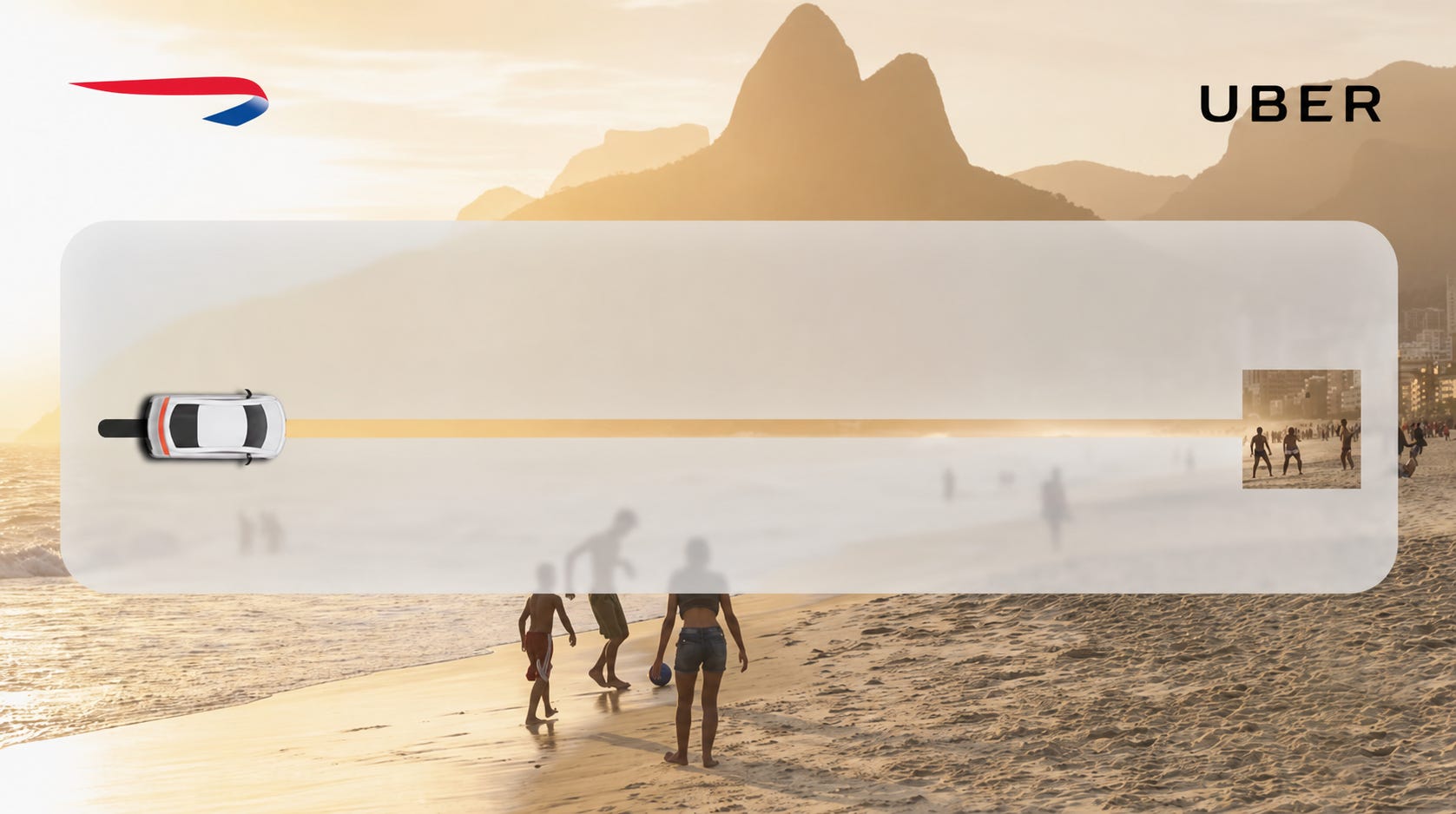
However, some businesses are already making more innovative and left-field partnerships across the traditional silo-boundaries within travel. British Airways, for instance, allows customers to link their Club and Uber accounts, earning Avios on eligible Uber airport rides, reserved journeys, rail and Eurostar bookings, and qualifying Uber Eats orders. The clever part is not merely the reward, more that it connects everyday mobility and food spending with the aspiration to travel.
It also offers a practical tie-up. You book your flight and you can also book – and be further rewarded for – transport to and from the airport, rides while away, and food and drink while there and on your return. In many ways this is a textbook example of what CustomerX is all about: collaboration that drives benefit for all, creates brand loyalty and, the point not often spoke aloud, increases the data that the collaborating brands can harvest.

A similar travel-adjacent partnership can also be seen between Tesco and Virgin. Like BA-Uber, Tesco Clubcard customers can similarly convert Clubcard points into Virgin Points, turning the weekly grocery shop into flights, hotels and other travel rewards.
Mastercard, meanwhile, approaches the moment through utility rather than points, expanding its airport Fast Track service to Madrid and Barcelona, adding an experiential travel benefit to the payment relationship from this month (July 2026), just in time for the Summer Holiday Moment.
These are useful beginnings, but many remain reward partnerships appended to existing transactions. The larger opportunity is to bind several parts of the Summer Holiday Moment together. For example, a holiday booking could trigger:
-
An optional “holiday preparation” service combining luggage, clothing, pharmacy products, insurance, an eSIM and airport transport
-
A connection, via a villa booking, with a local supermarket delivery, restaurant reservations and family activities
-
An offer, perhaps even delivered in real-time when the exact time of a return flight is confirmed, with an offer combining transport home and a grocery delivery or evening meal.
There are also less obvious participants. Pet-care companies, home-security providers and energy suppliers all have something relevant to offer when a household is going away. Photo-printing services and cloud-storage providers have a role when they return.
The partnerships are missing largely because companies organise around sectors, product lines and quarterly targets. The customer, meanwhile, is simply trying to get everyone packed without losing a passport.
Finally here, businesses may do well to keep a weather eye on what their partners are doing in the years ahead. One of the animating ideas behind CustomerX is that businesses in different sectors can learn from each other. This can result in them cooperating, but also in these businesses gaining commercial information that helps them move into new areas.
To do some blue sky thinking for a moment, Uber is now a taxi aggregator //and// a food delivery provider via Uber Eat. its market valuation is relatively high, its overheads are comparatively low. What if it bought a small airline and was able to test the water by offering a door-to-door service on particular journeys – and even an option that allowed people to have food delivered on arrival at the holiday destination and/or home? And if this is successful, what if it then bought a bigger airline?
AI as the holiday organiser
In the more immediate future, AI will increasingly link up different businesses because it can understand intent across a sequence of needs rather than match one search with one product.
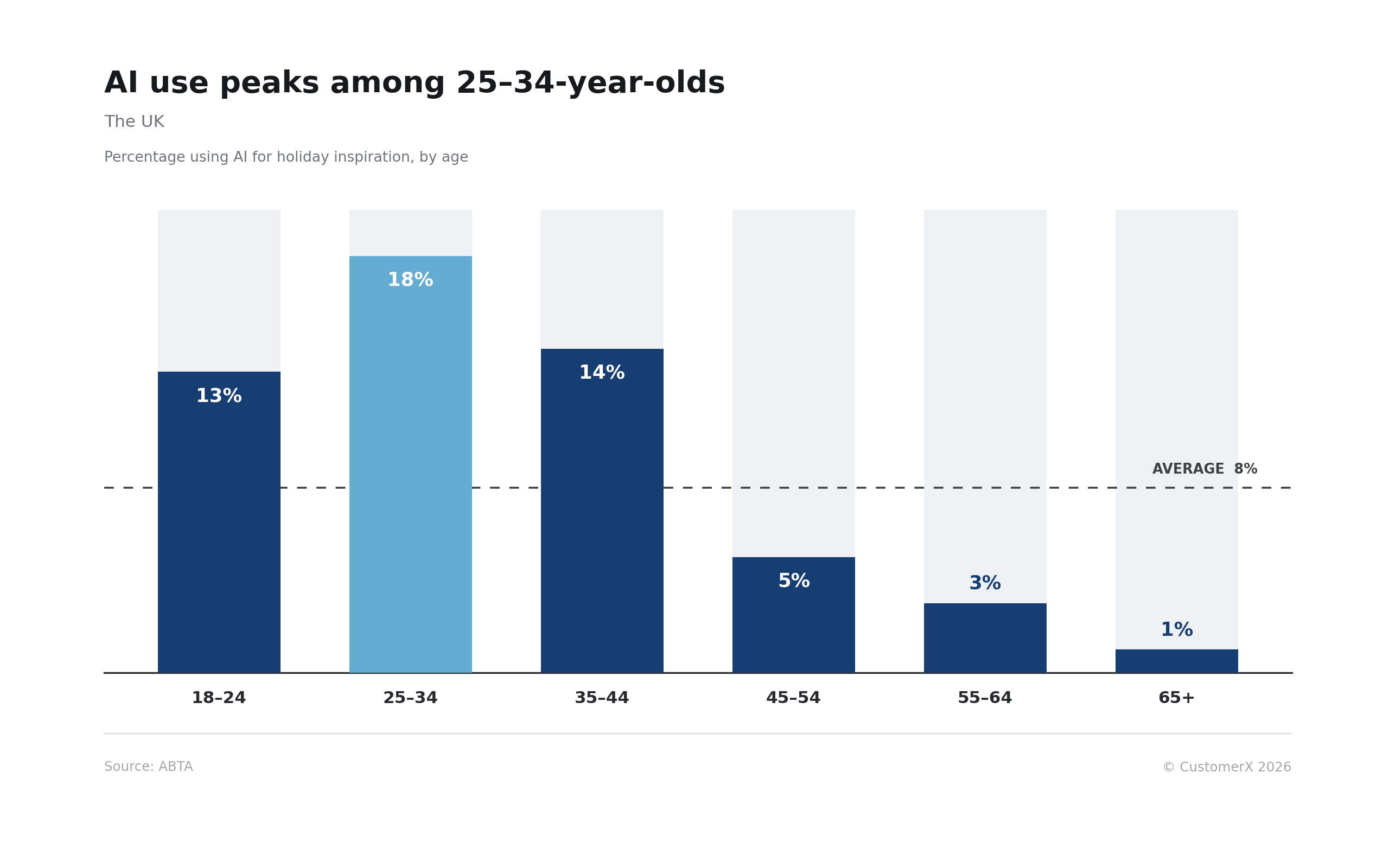
Adoption is still relatively modest but rising quickly. ABTA says the proportion of people using AI for holiday inspiration doubled from 4% to 8% in a year. It rises to 18% among 25-to-34-year-olds, while 43% of consumers say they would have some confidence in AI planning a holiday and 38% in AI making the booking.
There is, however, a familiar gap between curiosity and trust. Expedia Group’s 2026 research found that 53% are comfortable allowing AI to suggest travel options and 42% would use it to monitor prices. But 68% would still rather book with a trusted travel brand and 66% would not trust an AI assistant to purchase or book on their behalf.
That suggests AI’s immediate role is not to replace every intermediary, rather to coordinate them.
We can already see the beginnings of this with Booking.com’s app in ChatGPT that allows customers to describe the car they need and browse suitable rental options before completing the transaction. Google’s AI travel tools can also construct itineraries, compare flights and hotels and monitor prices, while Booking.com and Expedia offers are set to appear within AI-assisted trip planning at the time of writing.
As these systems develop, the winning recommendation may no longer be the cheapest flight or nearest hotel. It may be the most useful combination of flight, accommodation, transfer, insurance, connectivity, food and experiences for that particular customer.
That creates a challenge for businesses. They need accurate, machine-readable prices, availability, terms and service information. They also need partnerships that allow an AI to assemble a useful answer without sending the customer through seven disconnected checkout journeys.
Above all, they need permission. The CustomerX survey found consumers welcome marketing when it offers genuine value, is clearly relevant and comes from a trusted brand. That is very different from inferring a family holiday from one lonely bottle of factor 50 and pursuing the customer around the internet for six weeks.
Owning less, participating more
So, then, the commercial prize for brands, retailers and other commercial entities lies in participating at the point where a business is genuinely useful and collaborating with others to remove effort, uncertainty or cost. Sometimes that will mean selling something, sometimes it will mean providing information, rewarding an adjacent purchase or handing the customer smoothly to a partner.
On a practical level, brands wanting to tap into this market the starting point is to map the whole holiday journey and identify where their product solves a genuine need, rather than simply finding another place to advertise.
That might mean:
-
An airline partnering with a retailer, insurer, eSIM provider and transfer service to create an optional pre-departure bundle
-
A villa platform connecting guests with grocery deliveries and local experiences
-
A bank using consented travel signals to offer fee-free spending, insurance and airport benefits at the right moment.
The practical work involves sharing relevant – but strictly permissioned – data, linking loyalty schemes, making inventory and offers accessible through common APIs, and agreeing how customers, revenue and service problems will be handled across partners.
Brands should begin with one clearly defined customer problem, test a small partnership around it and measure whether it saves time, reduces cost or removes friction. The goal is not to surround the holidaymaker with more promotions, but to make several disconnected parts of the holiday feel like one joined-up experience.
The holiday industry may capture the booking, but the Summer Holiday Moment belongs to a much larger ecosystem. Its value is spread across the months before departure, the days away and the slightly deflated return to normal life.
Businesses that continue to see only flights, groceries, insurance, clothes or mobile data will capture their usual category spends. Those that understand why the customer is spending may capture much more.