)
)
)
The Streaming Standard: Why Zero-Friction is the New Baseline
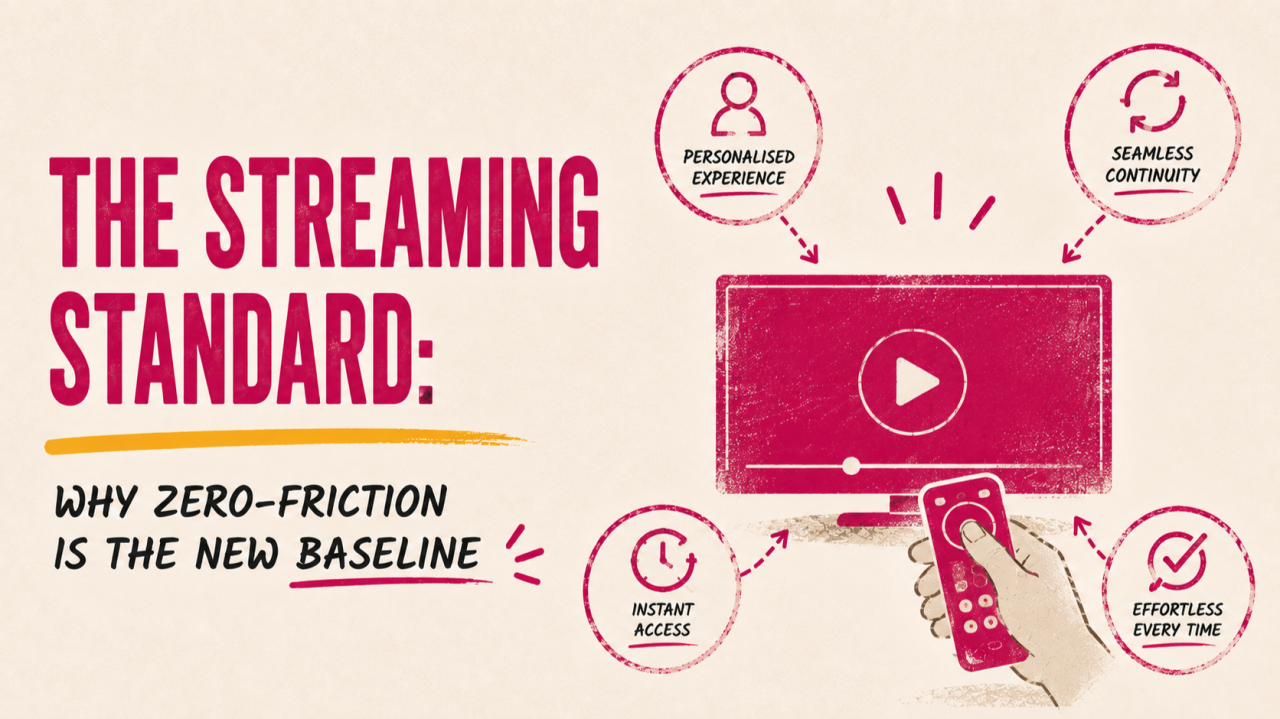
Every commercial leader knows the frustration of watching a customer abandon a high-value basket at the final hurdle. We often blame pricing, timing, or broader economic conditions, but the situation on the ground is often simpler. The customer simply got tired of the friction.
Consumers today live their digital lives in a state of zero-friction media. They open a streaming app and their exact preferences are waiting for them. The content picks up exactly where they left off, seamlessly switching from a living room television to a mobile phone on a train. When that same customer tries to book a family holiday or buy a premium winter coat online, the sudden drop in user experience is jarring.
They are asked to create another account, verify another email address, and re-enter payment details they provided just six months ago. Customers do evaluate your retail checkout by comparing it to the very best digital experiences they have every single day. Their expectations have been fundamentally and permanently rewired by the streaming giants.
Paul Skeldon, Editor at CustomerX explored this specific sense of exhaustion in a recent piece, Give me your tired, your poor, your huddled masses... and a sandwich, highlighting how modern shoppers are increasingly fatigued by the endless administrative hoops they have to jump through just to hand over their discretionary spend. If your buying process requires effort, they will easily take their finite wallet elsewhere. Discretionary spend is highly contested. A customer will happily abandon a frustrating retail purchase to fund a seamless leisure experience instead.
The painful gaps in retail and travel become obvious when you look over the fence at the media sector. A streaming platform knows when you are commuting and suggests a quick podcast to fill the exact duration of your travel time. A travel provider often does not even remember that you flew with them last month, asking you to manually input your dietary requirements all over again. These disjointed interactions remind the customer that they are being treated as a transaction.
Fixing these gaps does not require a total replatforming of your entire business architecture. Simple changes deliver disproportionate delight because the current baseline in retail is frequently so low. Remembering a sizing preference across categories, offering a true one-click payment method, or dynamically adjusting homepage recommendations based on the time of day can completely transform the lifecycle. It signals to the customer that you actually understand their context.
As noted in The Real Deal: Why brands need to get authentic, written by Jonathan Wright, Managing Editor, RetailX, understanding the actual context of a customer’s life is what builds real loyalty. You have to be present and relevant in the exact moment they are ready to spend, without adding unnecessary barriers to entry.
To win a greater share of this finite wallet, commercial teams need to adopt a new mindset. They copy, they collaborate, and they compete.
Innovation rarely happens in a vacuum. If a streaming giant has perfected the art of algorithmic curation to keep users engaged, a grocery director should not try to invent a brand new method from scratch. They should copy the mechanics of that success and apply it directly to the weekly digital shop. Priority content delivery in media translates perfectly to priority delivery slots in retail. The architecture of the customer path is identical, even if the end product changes.
This is exactly why single-sector thinking is fundamentally broken. If a retail operations director only ever looks at other retailers to understand how to drive conversion, they end up in an echo chamber. They sit and listen to the same competitors talk about the same minor incremental improvements. To secure sustainable growth in a stagnant market, you need the deep sector knowledge to see exactly what is working in completely different industries.
Creating environments where this cross-sector learning happens is exactly why we built our platform. Ambitious leaders are hungry for actionable insights rather than abstract theory. Technology alone is only part of the solution. You need to see exactly how a media company removes friction, and you need the peer-to-peer access to understand how you can adapt their infrastructure for your own checkouts.
When a senior hospitality executive sits down with a digital media director, the resulting exchange reveals how to build environments that actually protect customer loyalty. They share what failed, what succeeded, and how they integrated the technology to make it happen. Thirty qualified conversations with peers outside your immediate bubble will do more for your future growth planning than reading a dozen generic industry reports.
The market shift is happening right now. Customers have already erased the borders between industries. If you want to reach customers you do not yet serve and find new paths to sustainable growth, you need to be in the room where these conversations are taking place.
Find your fit and book your place at CustomerX - The Cross-Sector Commerce Summit. Join us to copy the best ideas, collaborate with new partners, and compete to win the future of customer spend. This is how you find your path in a market defined by the customer, not the category.