)
)
)
Give me your tired, your poor, your huddled masses... and a sandwich
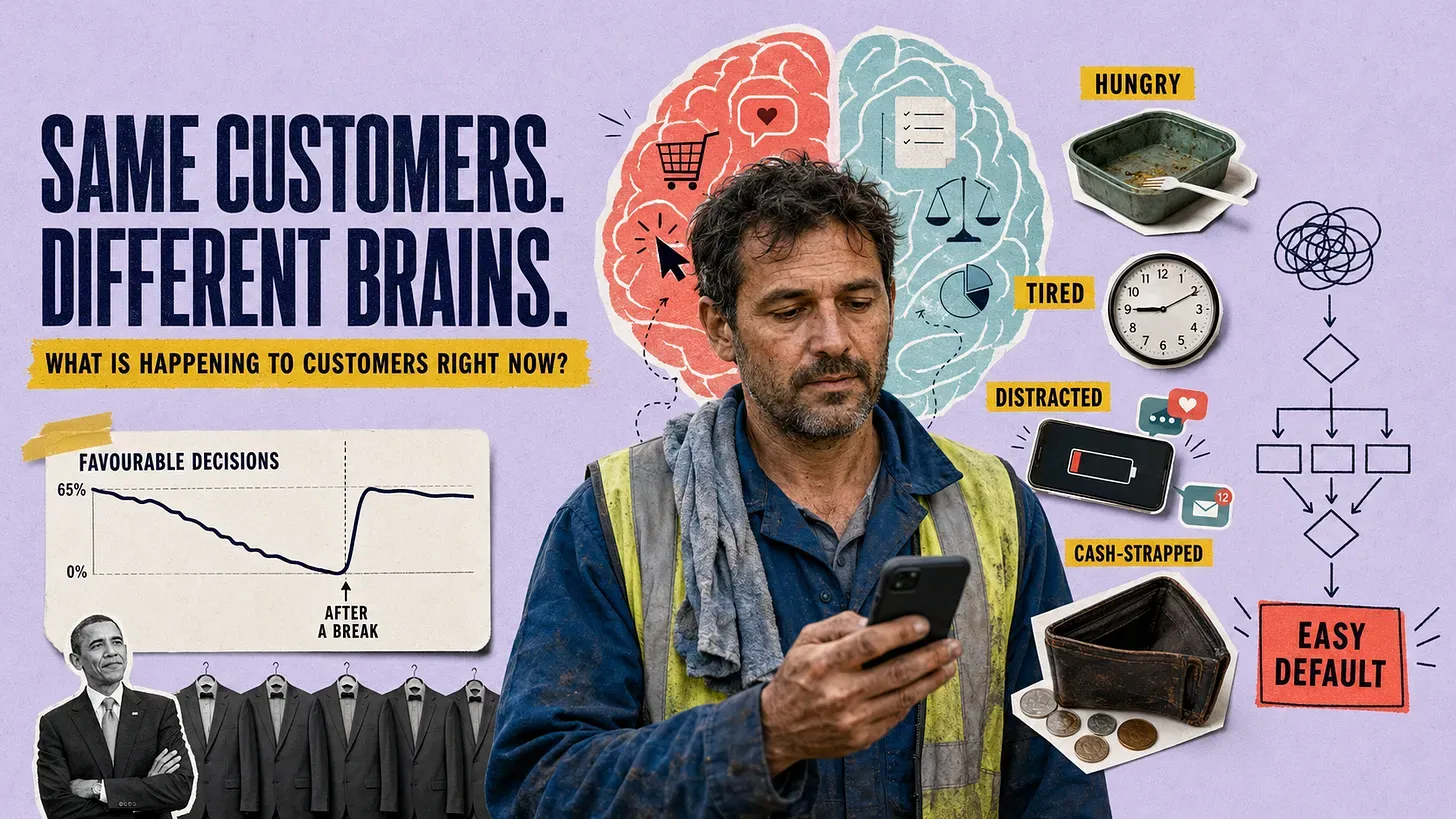
Understanding who your customers are is a fundamental part of marketing and customer engagement, but knowing what mood they are in, which brain they are using – rational or intuitive – is perhaps even more important. In this two-part series we look at how a sandwich can keep you out of prison and how financial strains don’t have the impact you might expect on how people spend.
Part 1 – How the same customer can have a different ‘brain’ depending on how hungry and tired they are, just ask an Israeli judge.
Part 2 – How financial strains shape behaviour in ways that are often counterintuitive and what businesses need to do to understand their tired, hungry and poor customers.
Part 1: Same customers, different brains
TL;DR ⬇️
-
The same customer can make different decisions depending on whether they are hungry, tired, stressed, distracted or under financial pressure – with unpredictable impacts on spending.
-
Hunger, fatigue and distraction can change what people value, how much information they process and whether they choose impulsively, rely on habit or postpone the decision altogether.
-
Customers do not possess separate rational and intuitive brains. Fast, automatic thinking and slower, more considered reasoning interact, with their relative influence changing according to available energy, attention and motivation.
-
Conventional data tells businesses who customers are. It reveals far less about the state in which they arrive: calm or stressed, rested or exhausted, planning carefully or urgently solving a problem.
-
Businesses must understand the customer’s entire moment – not merely their demographic profile or activity within one sector. Transport, food, payments and entertainment may all be competing for the same customer’s money, time and attention.
Never underestimate a sandwich. A judge considers a prisoner’s request for parole. The evidence, the law and the person appearing before them should determine the outcome. Whether the judge has recently eaten said sandwich should not.
Yet a famous study published in 2011 appeared to suggest precisely that. Researchers examined 1,112 decisions made by Israeli parole boards and found an extraordinary pattern. At the beginning of a decision-making session, prisoners had roughly a 65% chance of receiving a favourable ruling. That probability then declined, eventually approaching zero, before rising sharply again after a food break.
The obvious conclusion was irresistible: hungry judges are harsher judges. As the session wore on, the theory went, the judges became tired, hungry and mentally depleted. Granting parole required effort and justification, while refusal preserved the status quo. When their mental resources ran low, they chose the easier option.
The original research became one of the most famous illustrations of “decision fatigue”. It has since been used to explain everything from supermarket impulse purchases to why former US president Barack Obama limited his choice of suits. And this is something that brands need to factor in when looking at how they interact with consumers.
There is just one problem, the study may not prove what everyone thinks it proves – it may actually be more significant than that.
A subsequent reassessment of the hungry-judge effect in 2023 noted that favourable decisions took longer than refusals: an average of 7.37 minutes against 5.21 minutes. More complicated cases may therefore have been held over until the next session rather than started immediately before a break.
Computer simulations showed that this scheduling effect could produce a pattern resembling the original result even if the judges themselves were entirely consistent with no hunger pangs. The research also could not separate the effects of food from rest, time of day, case order and the way hearings were organised.
That does not mean the judges’ condition played no part. It means we cannot confidently say that hunger caused the pattern.
This qualification actually makes the story more interesting. The hungry-judge explanation became famous because it appealed to our intuition – it was simple, surprising and felt true. Instead, everyone was, initially, intuitively accepting of a study about people relying on intuitive judgment. A similar pattern can be seen everywhere with the mass judgement meted out on social media: tired, hungry, bored and saturated viewers rarely stop to consider what may lie beyond kneejerk – and usually totally unsubstantiated – calls to arms.
For businesses, however, the broader lesson remains important. Human beings do not approach every decision with the same needs, attention or capacity. A customer is not one stable decision-making machine. The person comparing energy tariffs on a quiet Sunday morning is cognitively different from the same person trying to order dinner on a delayed train after 10 hours at work.
Same customer. Different brain.
It is tempting to describe this as a contest between a rational brain and an intuitive one. Daniel Kahneman popularised something similar in his 2012 book Thinking fast and slow through System 1 and System 2: fast, automatic thought on one side and slower, more effortful reasoning on the other.
But these are not two separate pieces of biological machinery taking turns at the controls. Modern dual-process research treats them as different kinds of mental processing that interact. The proportion of which ‘brain’ takes the lead is dependent on many factors, including hunger, and results in decisions based on rational and intuitive thinking working together – rational thinking taking the lead when resources allow, intuition when depleted.
Rational thinking, more considered and less influenced by mood, is thought to lead to better, more reasoned thinking that takes account of the immediate and longer-term consequences.
But is intuition automatically bad? Not necessarily. An experienced shopper may recognise good value faster than they can explain it. A familiar brand, habitual order or trusted recommendation can be an intelligent shortcut. Conversely, customers can spend considerable time rationalising a decision that was emotionally attractive from the beginning.
The important distinction is effort. Comparing prices, assessing unfamiliar claims and reading detailed terms all consume attention. When customers lack either the bandwidth or motivation to make that effort, they become more likely to use shortcuts: habit, recognition, social proof, defaults, recommendations, delivery time or the easiest option to understand.
Sometimes they abandon the decision entirely.
So, how do hunger and other external factors affect what consumers do? Economist George Loewenstein described hunger, thirst, tiredness, pain, fear and craving as “visceral factors”: temporary bodily and emotional conditions that alter the relative attractiveness of different actions.
His research showed why it is misleading to regard preferences as completely stable. A hungry person does not simply want more food – hunger changes what captures their attention and how urgently they value immediate relief.
It also creates a hot-cold empathy gap, reasoned Loewenstein. When comfortably fed, rested and calm, people underestimate how differently they will behave when hungry, exhausted or distressed. Once in that “hot” state, they struggle to reconstruct what seemed important to their cooler self. My own partner – whose musings on the ‘hungry judges’ data inspired this article – readily attests to my “hot” state when hungry and the hilarious incompetence that usually ensues.
And this hunger spills beyond food. Five laboratory and field studies found that hungry participants expressed a stronger desire to acquire non-food products. In one experiment, they took more free binder clips when hungry, suggesting that hunger activates a general acquisition mindset not merely an appetite for something edible.
Tiredness changes the equation again. Research involving five consecutive nights of restricted sleep found that participants gathered less information before making decisions and displayed greater risk propensity. This does not mean every tired customer becomes reckless, but fatigue can produce impulsive action in one situation and defensive reliance on the familiar in another. Its consistent effect is to change the resources available for making the choice.
Distraction creates a similar brain tax. Even the mere presence of a person’s own smartphone has been found to reduce available cognitive capacity, including when the device is not being used. The researchers behind this “brain drain” study argue that resisting the urge to attend to the phone itself consumes mental resources.
This is the environment in which modern consumption happens: a customer compares insurance while receiving work messages, books a train while supervising a child, or chooses a mortgage on a screen also delivering breaking news, emails and social updates.
Conventional customer data is built around relatively durable characteristics: age, income, location, previous purchases and predicted lifetime value. These describe who the customer is. They say much less about the customer who turns up.
Yet their immediate state may be more predictive of what they need. Are they planning or reacting? Calm or anxious? Exploring or trying to escape a problem? Do they have 10 minutes to compare, or 10 seconds to complete?
Imagine someone leaving work late. Their train is cancelled. Their phone battery is running down. They are hungry, it is raining and there is nothing at home for dinner. Within minutes, transport, food delivery, grocery, payments, mobile connectivity and entertainment businesses may all encounter that fried person.
Each company sees a category transaction. The customer experiences one moment: “Get me home, feed me and make this evening easier.”
The real competition, then, is not simply for spending within a sector, it is for a share of the customer’s finite time, attention and cognitive capacity. A taxi is competing with a meal delivery, a convenience-store purchase with a streaming rental and a faster journey with the small indulgence that makes the delay bearable.
So, in short, how a customer is feeling, what time of day it is, what sort of day it has been and when they last ate, slept and relaxed are as important in personalised engagement as the basic demographic factors currently underpinning marketing and engagement today.
And then there is money. When things are tight financially, as we will see in Part 2, there’s an additional factor; the heavy cognitive load of choosing what to buy where there is a very real fear that making the wrong decision might lead to disaster.