)
)
)
Customers are not cutting back – they are cutting differently
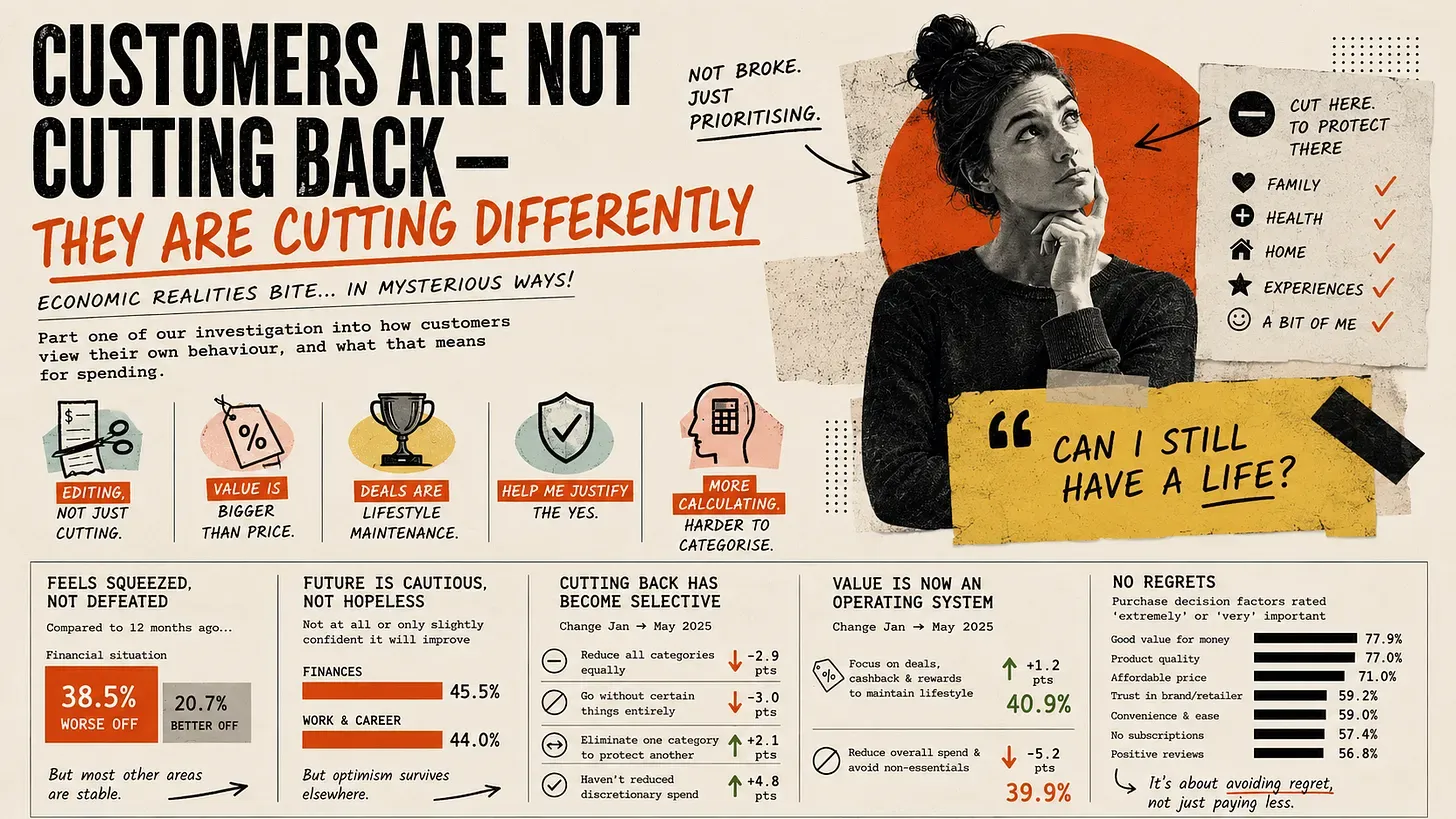
Economic pressures are changing how customers behave – with transformative impact on how they shop. In this three part look at a baker’s dozen of datasets, we delve into how consumers view their own behaviour, what that means for brands and how they can react
Part 1 – the simple economics facing consumers and how that translates into shopping habits
Part 2 – how that translates into ‘spending occasions’ and what that means for loyalty in an AI assisted world
Part 3 – how brands need to rethink how they market to customers and where, ultimately, people actually buy things – and it’s not where you think
Part 1: Economic realities bite… in mysterious ways
TL;DR ⬇️
The cost-of-living story is not as simple as “people are spending less” – they are spending more selectively.
Nearly four in ten say they are financially worse off than a year ago, but they do not describe their whole lives as falling apart. Consumers are not simply retreating — they are trying to stop financial pressure from infecting the parts of life they still want to protect.
So they are editing, not just cutting. Many are sacrificing one area so they can preserve another.
This is why “value” has become much bigger than price. Consumers still want affordability, but they also want quality, trust, convenience, good reviews and freedom from unwanted subscriptions. Cheap only works if it does not create regret.
That said, 40.9% now say they use deals, cashback and rewards to maintain their lifestyle, not simply to save money, but to keep living in a way that feels normal.
For brands, the message is clear – the squeezed consumer is not asking only for lower prices, they need help justifying the purchase: was it smart; was it worth it; did it solve something; did it let me keep a bit of the life I want?
The customer is not becoming less commercial and more calculating, more protective and much harder to categorise.
Contents
-
The customer feels squeezed, but not defeated
-
The future is cautious, not hopeless
-
Cutting back has become more selective
-
Value is now an operating system
-
No regrets
The lazy version of the cost-of-living story goes like this: people are under pressure, so they spend less. They trade down. They buy cheap. They cancel the fun stuff. They become rational little household accountants, moving solemnly through the supermarket with a calculator in hand and on the hunt for private-label products.
The data tells a story that’s far less straightforward. According to consumer survey data from RetailX, consumers are under pressure, certainly – nearly four in ten say they are financially worse off than they were 12 months ago – but that does not mean they are simply retreating from the marketplace. They are doing something more interesting and much more awkward for brands: they are editing their lives.
They are not acting like a single “consumer segment”, they are behaving like people trying to defend a version of normality. They cut here so they can preserve there. They trade down in one place to justify spending in another. They claim to be rational, but keep room for treats. They distrust marketing, but still respond to relevance. They use AI, but do not want it to take over. They want brands to know them, but not too well and only if the brands resonate with them.
These are the strange economics of the squeezed consumer – pressure does not make behaviour simpler, it makes it more inventive.
The customer feels squeezed, but not defeated
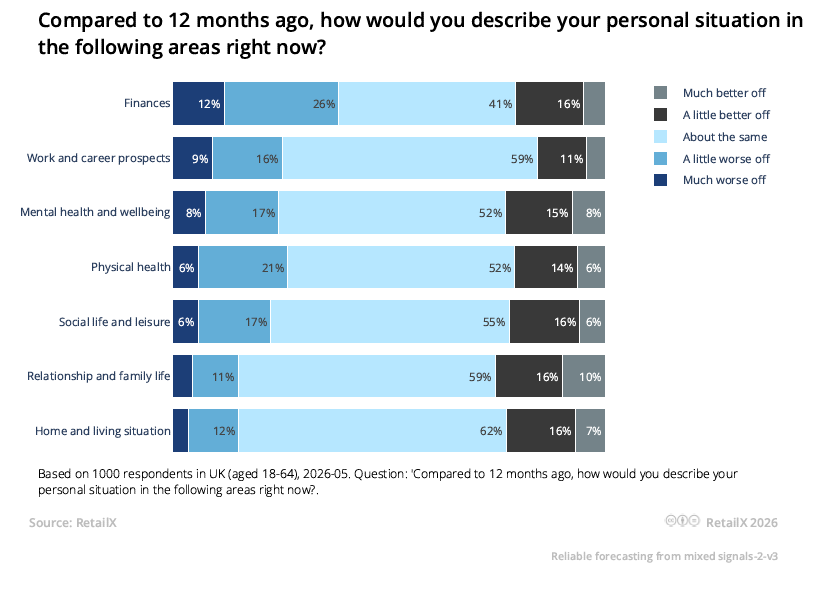
The first clue as to what’s happening can be found by looking at where the pain sits. Asked how their personal situation compares with 12 months ago, consumers are mostly negative about their finances. Some 38.5% say they are either much worse off or a little worse off financially, while only 20.7% say they are better off.
That sounds grim, but it is not the whole story. Across work, mental health, physical health, social life, relationships and home life, the largest group in each case says things are about the same. Attitudes to relationships and family life, for instance, remain unchanged for 59.4%, while home and living situation is stable for 61.8%.
This matters because it tells us the customer is not necessarily experiencing their whole life as collapsing; they are experiencing their finances as the pressure point that threatens the rest of it.
This is a subtle but important distinction. If everything were deteriorating at once, the response from brands would be simple: slash prices, remove friction, wait for recovery. But the data suggests something more active. Customers are not merely poor, they are protective. They are trying to stop the financial squeeze from spilling into every other part of life.
That is why so much current consumer behaviour looks contradictory. Someone may complain about bills, then still buy a premium product. They may cut back on restaurants, then book a holiday. They may switch grocery brands, then protect a subscription. This is not irrational. It is hierarchy. The customer is constantly deciding which parts of their life most deserve defending.
The future is cautious, not hopeless
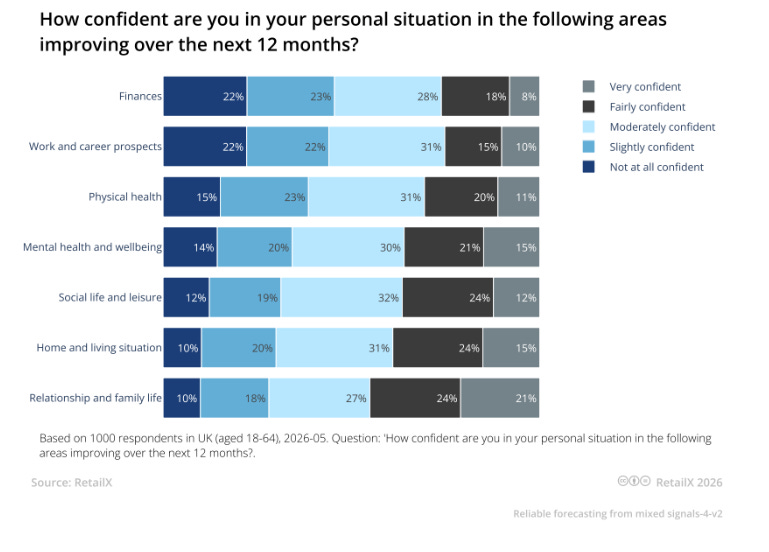
The chart above reinforces this. Consumers are cautious about the future, but not hopeless. Finances again sit at the difficult end: 45.5% are not at all or only slightly confident that their financial situation will improve over the next 12 months. Work and career prospects show a similar pattern, with 44% not at all or only slightly confident.
Yet optimism survives elsewhere. Attitudes toward relationships and family life are much more positive, with 45.1% fairly or very confident about improvement. Home and living situation is also more resilient, with 39% fairly or very confident. Mental health and wellbeing is finely balanced, with 36% fairly or very confident and 34.3% not at all or only slightly confident.
So, the customer’s life is not a single downward line, it is a series of competing ledgers. Money may be tight, but home, family, wellbeing, social life and identity still matter. In fact, they may matter more because money is tight.
This is where brands often misread the moment. They see pressure and assume the customer wants only cheaper things. But the customer may be asking a more complicated question: what helps me feel that I am still moving forward?
A furniture retailer is not just selling beds, sofas and sideboards. It is selling the possibility that home can improve. A beauty brand is not just selling moisturiser. It is selling control, self-care or confidence. A food brand is not just selling dinner. It is selling household normality, even the comfort of a hearty meal. A telecoms provider is not just selling connectivity. It is selling access to work, entertainment, family and life admin. The category matters less than the customer context it helps protect.
Cutting back has become more selective
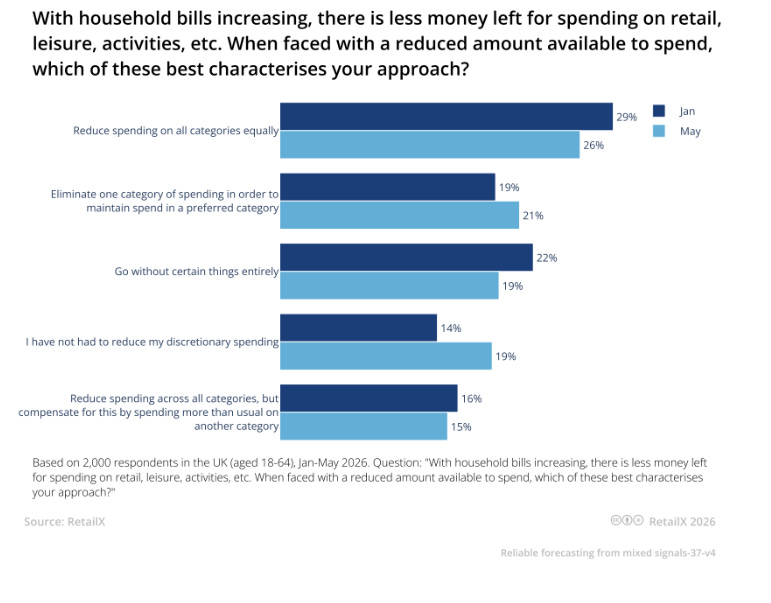
The third chart (above) is where the story gets yet more interesting. When faced with less money for retail, leisure and activities, the share of consumers saying they reduce spending on all categories equally fell from 29.2% in January to 26.3% in May. The share saying they go without certain things entirely also fell, from 22.2% to 19.2%. Meanwhile, the proportion eliminating one category of spending in order to maintain spend in a preferred category rose from 18.9% to 21%. The proportion saying they have not had to reduce discretionary spending rose too, from 13.8% to 18.6%.
This is not simply cutting back – this is ‘portfolio management’.
The household budget is no longer a flat spreadsheet, more a battlefield of priorities. One category gets sacrificed so another can live. The customer is asking: what part of my life do I refuse to give up?
That question changes the competitive landscape. A restaurant is not only competing with another restaurant, it is competing with a streaming subscription, a grocery upgrade, a holiday deposit, a mobile contract, a beauty product, a gym membership, a child’s school shoes, a home improvement purchase and a cashback offer that makes something else feel justifiable.
This is why sectors are becoming less meaningful to consumers. Companies may still organise themselves around retail, leisure, travel, telecoms, financial services, grocery or entertainment, but customers do not. Customers live inside occasions and they spend around needs, moments, habits, emotions and permissions. This is the fundament of why CustomerX exists.
The customer does not wake up and think: “Today I shall allocate discretionary spend between retail, leisure, travel, telecoms and personal care.” They think: “Can I still have a life?”
Value is now an operating system
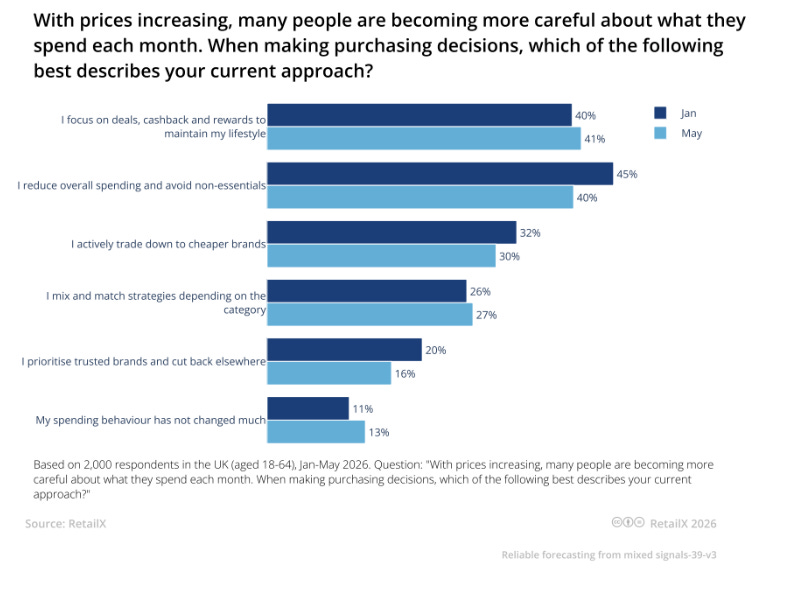
That is why this next chart may contain one of the most important statistics in the whole survey. In May, 40.9% said they focus on deals, cashback and rewards to maintain their lifestyle, up from 39.7% in January. At the same time, the share reducing overall spending and avoiding non-essentials fell from 45.1% to 39.9%. Actively trading down to cheaper brands also fell, from 32.5% to 29.8%.
The phrase that matters is “maintain my lifestyle”. Consumers are not only looking for cheaper ways to survive, they are looking for smarter ways to continue. A deal is not just a discount, it is an alibi. Cashback is not just money back, it is moral cover, rewards are not just mechanics, they are permission slips.
This is the psychology of the modern squeezed shopper. They want to feel responsible without feeling diminished. They want to save money without becoming someone who only buys the cheapest thing. They want proof that the purchase is sensible, but still want the purchase.
Brands should take note: the customer is not necessarily asking for less, they are asking for help making the “yes” feel justified.
That is a very different commercial problem. It means value cannot be reduced to price. Rather, it is about the story the customer can tell themselves after the transaction.
To help give this story a happy ending, brands may want to think about helping the customer answer the following questions about their purchase:
• Was it worth it?
• Was it smart?
• Did it solve something?
• Did it avoid regret?
• Did it let them keep a little bit of the life they want?
No regrets
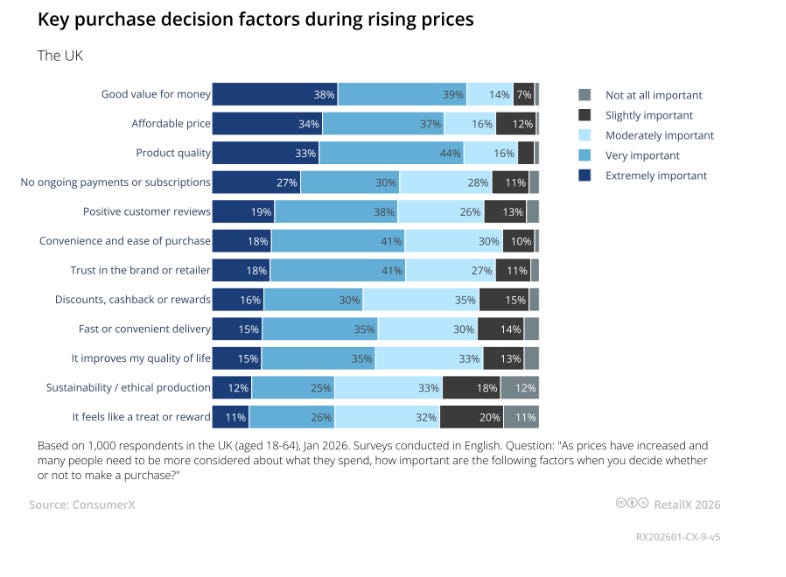
The purchase decision factors make this even clearer, as seen above. Good value for money is extremely or very important to 77.9% of consumers. Affordable price is important too, at 71%. But product quality is extremely or very important to 77%, almost identical to value and higher than price alone. Convenience and ease of purchase matter to 59%. Trust in the brand or retailer matters to 59.2%. No ongoing payments or subscriptions matters to 57.4%. Positive customer reviews matter to 56.8%.
This is not a race to the bottom – if it were, affordable price would dominate everything. Instead, consumers appear to be building a risk model.
Cheap is good, but only if it works. Quality matters because a bad purchase is more expensive when money is tight. Trust matters because the consumer has less tolerance for being messed around. Reviews matter because assessing other people’s experiences can help reduce the odds of regret. Convenience matters because wasted time is another hidden cost. No ongoing payments or subscriptions matter because consumers are increasingly wary of financial commitments that quietly follow them around.
This is where the “value” conversation often goes wrong. Many businesses treat value as a synonym for discount. Consumers do not. They treat value as the relationship between money spent, risk taken, time used, quality received and future hassle avoided.
In other words, the customer is not asking is this cheap, they are asking will I regret this? That question is much harder for brands to answer with a red sticker. In part two we look at how customer say they do then want to interact with brands – and where AI plays a role.