)
)
)
The Big Sporting Moment: where cross-sector success is the goal
TL;DR ⬇️
-
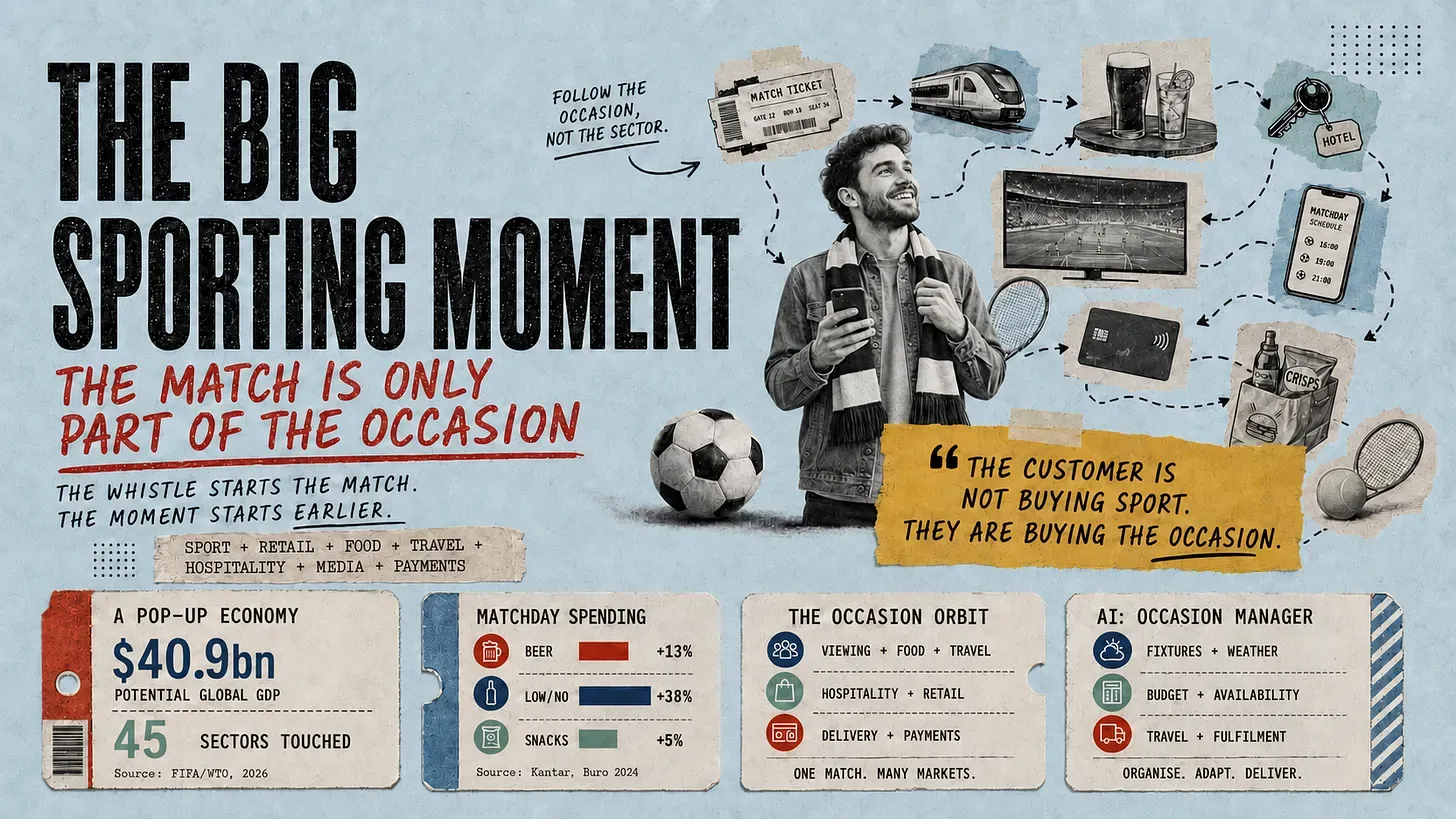
Big sporting events do not create one market, they temporarily reorganise spending across food, drink, travel, hospitality, retail, entertainment and technology.
-
Customers do not think in sectors. They think: where are we watching, who is coming, what do we need and how are we getting home?
-
The match is only the centre of the occasion. Commercial opportunities begin during planning and continue through travel, viewing, socialising and the post-match aftermath.
-
Brands should focus less on attaching their logo to sport and more on making the occasion easier, better or more memorable.
-
That requires partnerships between broadcasters, retailers, delivery platforms, transport operators, hospitality businesses, payment providers and local services.
-
AI can act as the occasion manager – connecting fixtures, weather, availability, budgets and personal preferences – but must remain useful rather than exploit fans’ heightened emotions.
-
The winners will be the businesses that understand the whole customer context. The whistle starts the match, but the commercial moment begins much earlier.
For all the complex diversity and non-linearity of the digital world, few things unify customer attention quite like somebody blowing a whistle. The FIFA World Cup, Wimbledon, the Olympic Games and many other major sports events create something increasingly rare: millions of people doing the same thing at the same time. They may primarily be in a stadium, but they are also in a pub, a fan zone, a hotel or a home complete with shouting unhelpful tactical advice at the TV, but attention is synchronised.
A pop-up economy built around emotion
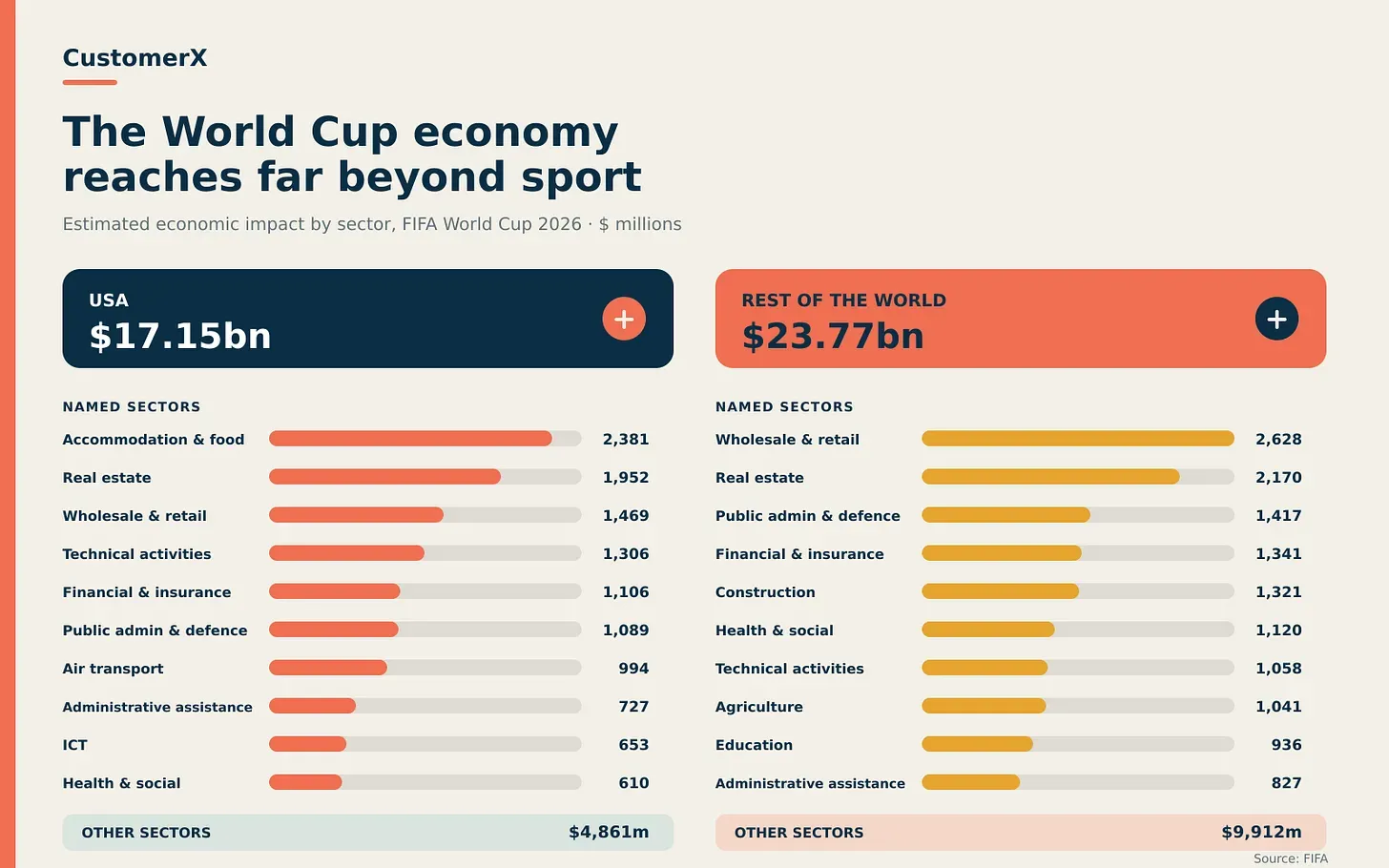
The scale of these occasions is difficult to overstate. Before the 2026 FIFA World Cup, a FIFA and World Trade Organisation-commissioned study estimated that 6.5 million people would attend matches and that the tournament could generate up to $40.9bn in global GDP while supporting nearly 824,000 full-time-equivalent jobs.
Significantly, the modelling covered activity across 45 different economic sectors.
Visa’s post-tournament transaction data, meanwhile, describes what emerged across the US, Canada and Mexico as a series of “pop-up economies”. Cross-border Visa transactions in host cities rose by almost 20% year-on-year, with consumers spending most heavily on transport and entertainment. Tap-to-pay transactions increased by nearly 12%, while restaurants, hotels, retailers and local services all shared in the uplift.
The particularly interesting finding was how quickly those economies moved. Norway’s unexpected progress to the quarter-finals nearly doubled transaction volumes during its matches at home, while increased spending was eventually detected across more than 60 countries when the team played.
In other words, a goal did not merely alter the score, it altered demand.
The effect is not confined to people wealthy or fortunate enough to attend. At Euro 2024, Kantar found that UK beer sales increased by an average of 13% on days when England played, while crisps and snacks rose by 5%. More revealingly, sales of low-alcohol and no-alcohol beer soared by 38% on matchdays. This was not simply an alcohol occasion, it was a social occasion being adapted to different lifestyles, working days and budgets.
When England reached the final, Barclays recorded a 195.6% year-on-year increase in transactions in pubs, bars and clubs on the day. Yet total consumer card spending across July still declined by 0.3%. The Sporting Moment did not magically make consumers richer. It persuaded them that this particular experience was worth protecting.
That fits closely with CustomerX’s own consumer research. Shoppers under financial pressure are not reducing every kind of expenditure evenly. They are cutting differently – sacrificing some purchases to preserve the occasions, categories and treats that matter most.
Sport is particularly good at supplying the necessary justification. A takeaway is an expense. A takeaway for the semi-final is part of the event.
Where the money travels
Some spending is obvious: tickets, hospitality, travel, accommodation, food, drink, merchandise, broadcasting subscriptions and betting. But much of the sporting economy sits one or two steps away from the game.
There are televisions, projectors, garden furniture and barbecue equipment. There are replica shirts, cosmetics, flags and last-minute fancy dress. There are taxis, rail tickets, roaming packages and portable phone chargers. There are restaurant bookings before the match and takeaway orders afterwards. For travelling supporters, insurance, foreign exchange, luggage and sightseeing need to be factored in – as we have seen in the Summer Holiday Moment. For those staying home, there may be childcare, pet care and the emergency purchase of six additional chairs.
Mastercard found that 58% of Europeans planned to attend at least one sporting event in 2025, with 40% expecting to spend between €101 and €1,000. At the 2024 Champions League final in London, restaurant and bar spending within three kilometres of Wembley rose 7.4% above the level Mastercard estimated would otherwise have occurred, while cross-border spending was 67 times higher than on a typical weekend.
The difficulty is that these purchases are still largely treated as separate markets. The broadcaster owns the viewing relationship. The supermarket sees a grocery basket. The pub sees a table booking. The railway sees a journey. The hotel sees a room. Nobody necessarily sees the whole occasion. Customers, meanwhile, must assemble it themselves.
Brands beginning to understand the moment
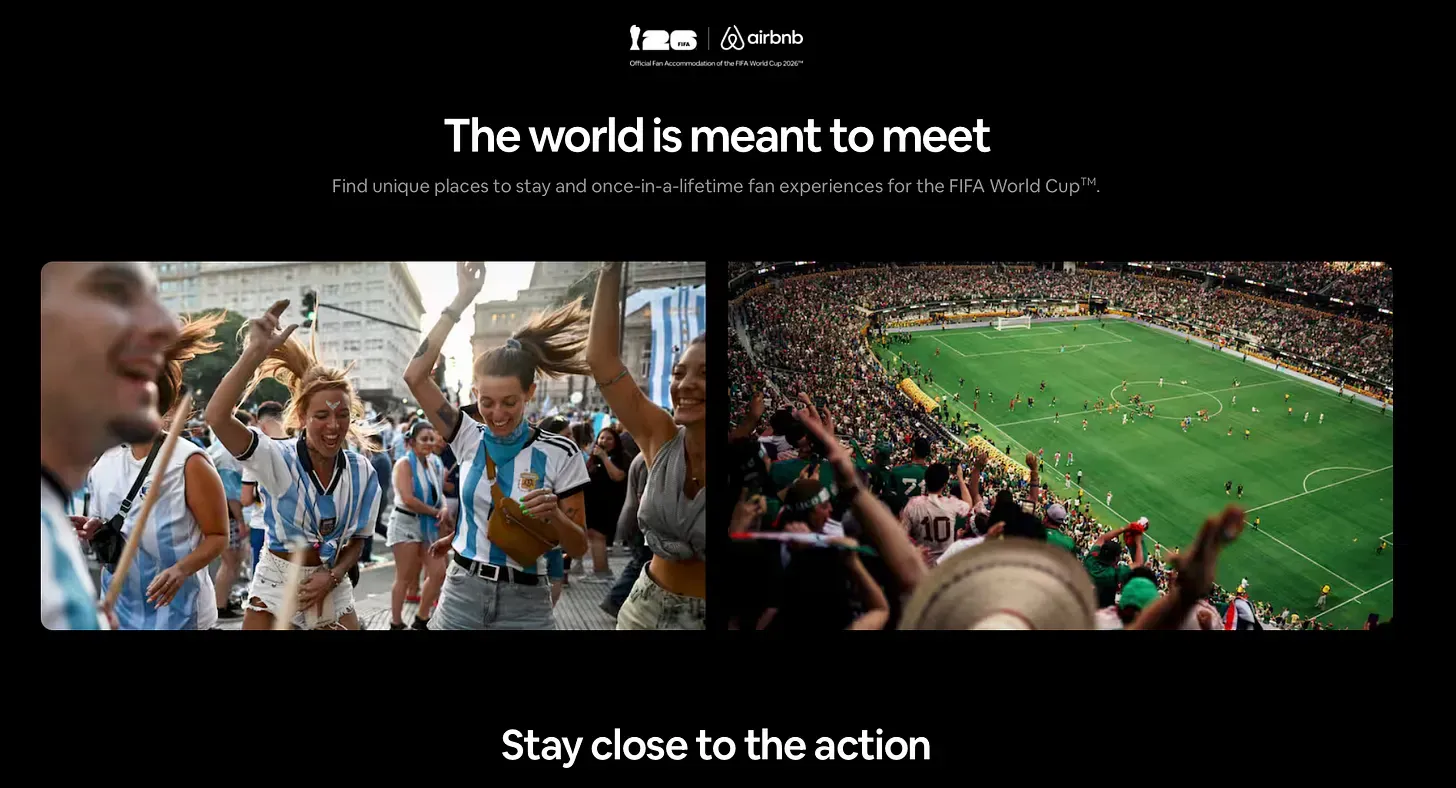
Some businesses are starting to move beyond conventional logo-led sponsorship, however. Airbnb became FIFA’s official alternative accommodation and experiences platform, connecting stays with local activities and football experiences. More than 380,000 Airbnb guests were expected to travel during the 2026 World Cup, contributing an estimated $3.6bn to host-city economies. That is much closer to the customer’s actual context: not merely, “I need a room,” but, “I am travelling to experience the World Cup and the city around it.”
Visa and Marriott Bonvoy similarly linked payments, accommodation, tickets, fan festivals and destination content across 104 matches and three host countries. DoorDash’s FIFA partnership extended through Deliveroo and Wolt, recognising that a tournament taking place in North America also creates a delivery occasion in living rooms across Europe.
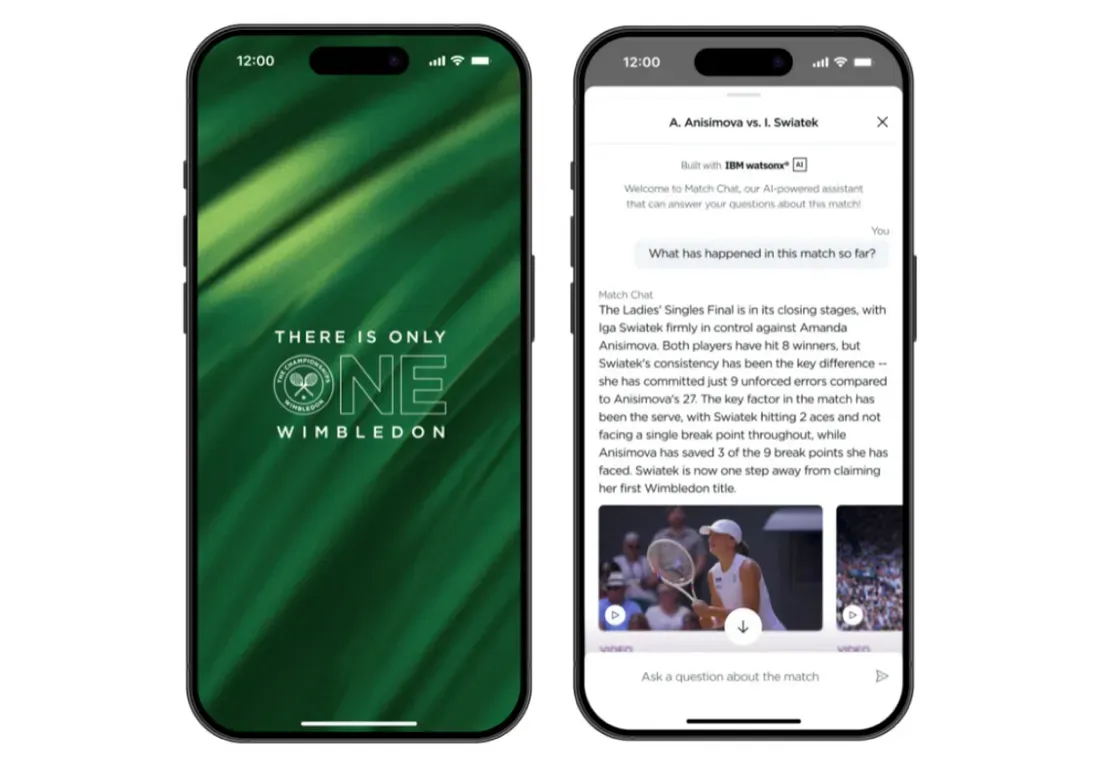
At Wimbledon, IBM’s AI-powered Match Chat, Key Moments and Likelihood to Win tools turned the tournament’s website and app into companions to the live action rather than static information services. The All England Club said its digital work contributed to a 16% year-on-year rise in engagement across its platforms in 2025 and a 39% increase in registered myWimbledon users. For 2026, the service used AI agents trained on Wimbledon’s editorial style and tennis language to explain momentum and answer questions during matches in natural, conversational language.

UK telco Vodafone also got in on the action, with a robot arm powered by 5G+ – a precursor to 6G – capturing live data from the Wimbledon broadcast feed and streaming it over a dedicated 5G+ network slice, allowing the arm to mirror the speed, power, angle and trajectory of professional serves as they happen.
The tie-up was something of a novelty used to demo Vodafone’s next-gen tech, but it was also an interesting co-marketing opportunity and linked Wimbledon with its fans in a new way.
Taken together, all of these are important developments, but most still sit within official sponsorship ecosystems. The larger opportunity is to connect all the less glamorous but highly valuable jobs surrounding the occasion.
The partnerships that should come next
Imagine a broadcaster, supermarket, delivery platform and payments provider collaborating on a watch-party service. The customer selects the match, number of guests, budget and dietary requirements. The service assembles a food and drink basket, schedules delivery, offers a pub alternative if nobody wants to host and allows the cost to be divided between friends.
A transport operator, pub group and fan-zone organiser could combine live capacity, journey planning and table availability, steering supporters towards places they can actually reach and reducing the familiar matchday ritual of queuing outside a completely full pub.
Hotels and accommodation platforms could work with independent restaurants, local retailers, museums and transport providers to build neighbourhood itineraries around fixtures. Electronics retailers could partner with rental or resale businesses so customers can upgrade their home-viewing experience for the tournament without buying equipment they will barely use afterwards.
Fashion and merchandise also need to become more responsive. Tournament demand is shaped by results that cannot be known in advance. A surprise run creates instant interest in shirts, flags, collectibles and celebration products. Shared inventory and fulfilment data could allow retailers, manufacturers, delivery companies and resale platforms to react while the emotion is still alive.
This matters because the customer journey is already cross-surface. CustomerX research found that 47.44% of shopping still happens in-store, compared with 27.81% through a browser, 16.27% through retailer apps and 4.81% through social platforms. Discovery and planning may be digital, but the physical store remains the largest commercial surface. Sporting-moment partnerships therefore need to join online intent to local availability, not assume everything ends with an ecommerce checkout.
How brands can get match-fit
For brands wanting to enter this world, the first requirement is to stop thinking about the sporting event as a media-buying opportunity and start treating it as a customer occasion –mapping the whole moment:
-
What happens before, during and after the match?
-
Where will customers be?
-
Who will they be with?
-
What might prevent the occasion from going to plan?
-
Which purchases are prepared weeks ahead and which are triggered by the weather, the result or the sudden realisation that nobody has bought any ice?
This should reveal where the brand can be genuinely useful. A supermarket may help assemble the watch party. A bank or payments provider can make it easier to divide the bill. A transport business can help supporters reach the venue or get home after extra time. A hotel can connect visitors with the life of the host city. Even brands with no obvious link to sport may have a role if they solve one of the jobs surrounding it.
The next step is to decide which partners are required. Very few businesses can deliver an entire sporting occasion alone. Brands need to identify the broadcasters, retailers, hospitality operators, transport providers, delivery platforms, payments companies and local services that already occupy other parts of the customer’s plan.
This is where commercial ambition must be matched by technical preparation. Partners need to establish which data can be shared, how consent will be managed and whether inventory, bookings, pricing and fulfilment systems can respond in real time. There is little value in promoting the perfect matchday package if the pub is full, the shirt is unavailable locally or the food arrives after the final whistle.
Brands must also prepare for volatility. Sport does not follow the campaign calendar. A team can be eliminated early, progress unexpectedly or become the centre of national attention almost overnight. Matches are delayed, moved or extended; weather changes viewing plans; individual players suddenly become heroes or villains.
The strongest operators will therefore plan around scenarios rather than a single predicted journey.
They will prepare different creative, offers and inventory strategies for victory, defeat, qualification, elimination and the unexpected success of an unfancied team. They will also give local teams enough authority to react while the moment is still culturally alive. By the time a response has passed through several layers of approval, the conversation – and often the tournament – may have moved on.
Relevance matters more than official status. Not every business needs to spend heavily on sponsorship rights, but those without them must understand the rules governing trademarks, imagery and event references. Ambush marketing can produce attention, but it can also produce legal letters and make a brand appear opportunistic. Often, owning a useful part of the customer occasion is more valuable than borrowing the language of the tournament itself.
Finally, brands need to recognise that not everyone experiences sport in the same way. The opportunity extends beyond committed supporters to families, occasional viewers, travelling partners, hospitality workers and people drawn primarily by the social occasion. Offers should accommodate different budgets, dietary needs, accessibility requirements and relationships with alcohol and gambling.
The commercial question is not simply: “How do we attach our brand to this event?” It is: “What does the customer need in order to enjoy this occasion, and which other businesses must we work with to provide it?”
The brands that answer that well will not merely appear beside the Sporting Moment. They will become part of what makes it work.
Winning beyond the scoreboard
Big Sporting Moments show particularly clearly why sectors are becoming a poor way to understand customers. The customer does not allocate money to “the sports economy”, they create an occasion involving friends, travel, food, screens, clothing, payments, hospitality and memory.
The businesses that win will be those that understand their role in that complete context and collaborate with the other businesses already present in it. The whistle may start the match, commercially, however, the moment began days or months earlier – and its value can continue long after the crowd has gone home.