)
)
)
The back to school moment: a summer-long tax on other moments
-
Back to school is not a late-August retail event but a summer-long moment that competes directly with holidays, days out and other discretionary spending – and which kicks off the ‘peak-peak’ season
-
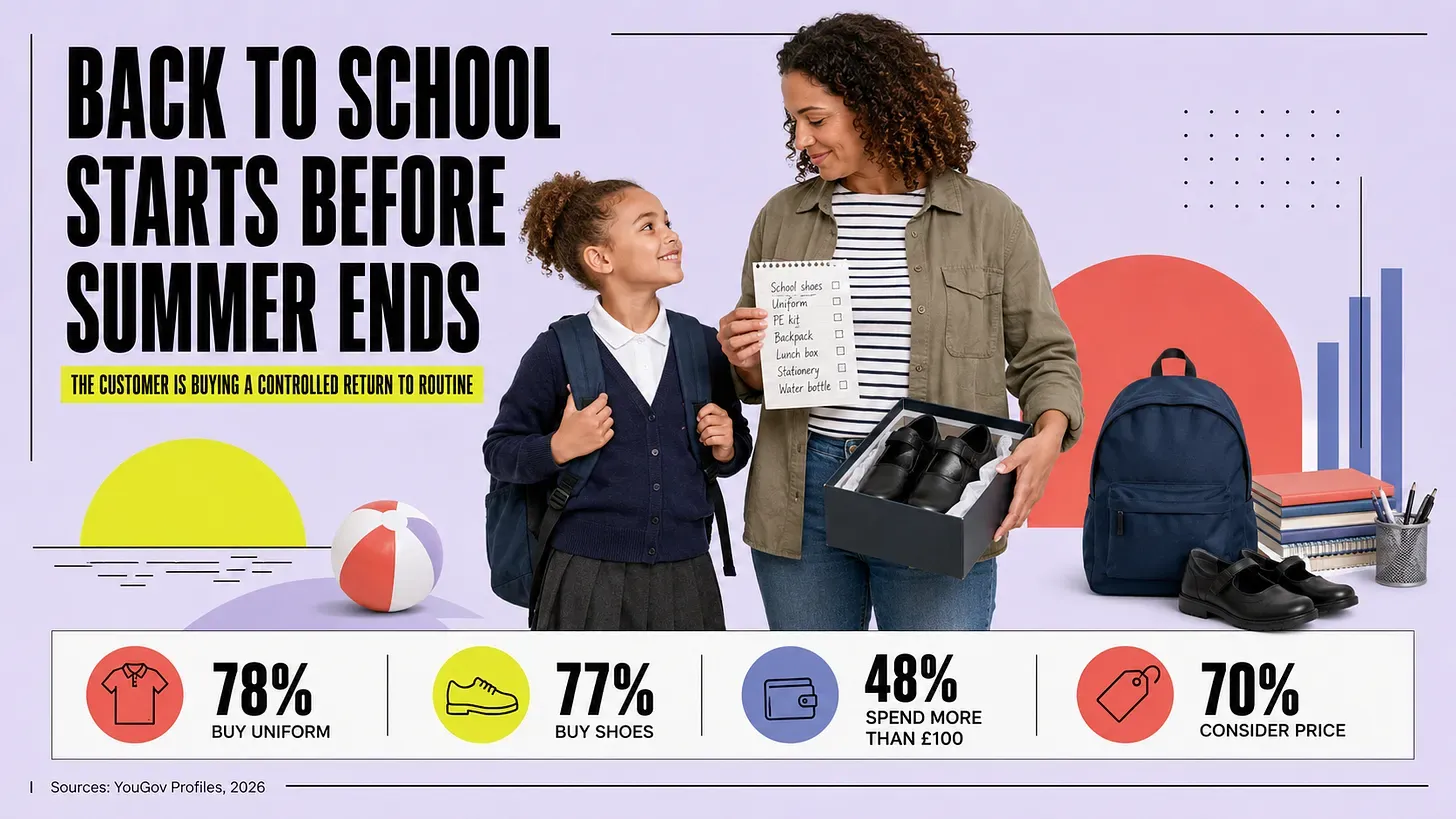
Almost half of parents spend more than £100, with uniform, shoes, stationery, PE kit and bags dominating – but the wider occasion also encompasses food, transport, childcare, technology, healthcare and activities.
-
Parents want value rather than simply low prices: 70% consider price and 68% product quality, closely reflecting ConsumerX survey findings.
-
The biggest opportunity lies in cross-sector partnerships connecting retailers, banks, reward platforms, transport providers, schools, healthcare businesses and leisure brands around the complete return-to-routine journey.
-
AI could turn school lists, sizes, budgets and existing possessions into a personalised summer buying plan. The customer is not buying school supplies, they are buying a controlled return to routine.
The school gates have only just reopened, but the back-to-school moment began before they even closed. It started when a parent notices that a child’s trousers have become ankle swingers. It gathers pace when the school emails its uniform list. It becomes urgent when somebody remembers, three days before term, that the PE shoes fell to bits in May.
This is less a shopping event than a summer-long transition: from spontaneity, leisure and lie-ins to timetables, packed lunches and alarm clocks. It also presages the beginning of what is becoming ‘peak-peak’ season, where back to school morphs into halloween and on into Christmas.
The timing matters. Our previous CustomerX analysis explored the summer holiday as an occasion around which travel, hospitality, entertainment, payments and retail spending coalesce. Back to school does not politely wait for that moment to finish. It competes with it.
Save the Children’s Big Summer Survey 2026 found that 34% of parents go without things themselves to meet back-to-school costs, while 28% cut household spending and 19% borrow or use credit. A quarter cut their own food shopping, while 29% reduce spending on hobbies and social activities.
So, yes, back to school impinges on the summer holiday moment. It acts as a tax on spontaneity. Another meal out, attraction ticket or extra night away is weighed against the shoes, bag and blazer still to be bought.
One moment, many baskets
That said, back to school’s visible spending remains heavily concentrated in familiar categories. YouGov Profiles data shows that 78% of parents buy uniform, 77% shoes, 58% stationery, 55% PE kit and 53% bags. Lunch boxes, books, other clothing and electronic devices extend the basket further. Almost half of parents spend more than £100.
Yet that still understates the occasion. Back to school also means haircuts, eye tests, transport, breakfast food, childcare, sports and music activities, broadband, software subscriptions and, increasingly, refurbished technology. The customer does not see eight sectors, they see one job: getting the family ready for September.
Colin Horan, Strategic Partner, FMCG at Bauer Media Outdoor, captures this broader context: “Back to School is no longer simply a retail event. It has become a broader cultural and commercial moment, marking the transition from the spontaneity of summer to more structured routines. During the run-up to September, the opportunity for brands extends beyond offering discounts to building meaningful preference, as 70% of parents consider price when choosing where to shop, and 68% consider product quality.”
“With competition for attention, brands should resist the temptation to rely solely on promotional messaging or short-term offers. Instead, they should focus on building distinctiveness and creating preference before consumers reach the point of purchase. The brands that stand out will be those that understand the changing context around Back to School and find relevant ways to show up in consumers’ everyday lives.
Those price and quality figures closely mirror the wider ConsumerX survey, in which 77.9% prioritised good value and 77% product quality. This is not a hunt for the cheapest possible basket. Parents need permission to believe they are spending wisely: that an item will last, arrive in time and not need replacing by half-term.
Some businesses have begun to understand this. The M&S, Oxfam and eBay school-uniform partnership connects new retail, donation, resale and charity fundraising. It tackles affordability and sustainability together, rather than treating second-hand clothing as a threat to new sales.
Similarly, the government’s breakfast-club programme has brought together schools, Morrisons, Sainsbury’s, Weetabix and Magic Breakfast. The partnerships provide food, vouchers, discounted supply and delivery – a useful example of brands participating in the school routine rather than merely advertising around it. The government says breakfast clubs can save families £450 and free up 95 hours a year.
The partnerships still missing
The larger opportunity, however, is to connect the fragmented preparation journey. Banks, cashback platforms and employee-benefit providers could assemble school wallets covering uniform, shoes, stationery and refurbished devices.
Grocers could combine uniform purchases with packed-lunch plans and breakfast subscriptions. Transport operators could work with schools, mapping providers and insurers on safe-route packages.
Opticians, dentists, sports clubs and hairdressers could join a single “ready for September” booking journey.
Holiday companies could even acknowledge the collision directly, offering back-to-school savings or retailer rewards alongside family bookings. That would allow the summer holiday and school moments to support one another, instead of silently fighting over the same money.
AI can provide connective tissue. An assistant could ingest a school’s requirements, remember sizes and existing items, identify what can be reused, compare price with durability and spread purchases across the summer.
In the US, NRF research found 61% of back-to-school shoppers used generative AI or other AI-powered shopping tools in 2026, particularly for recommendations and finding deals.
For businesses, the prize is not simply a better-targeted uniform advert. It is becoming part of a trusted, cross-sector plan – while handling family and children’s data with appropriate restraint.
The customer is not buying school supplies, they are buying a controlled return to routine. The brands that recognise that whole moment, and collaborate around it, can earn more than a late-August transaction. They can become part of how family life starts again.
And those that acknowledge how it heralds the start of ‘peak-peak’ will also win through, if not just through sheer honesty in recognising that customer budgets are being spread thin across this quarter of moments. But that’s another story, in our next piece. Stay tuned.